Coordinate the model. Track every change.
BidLight versions every model export, diffs it element by element, and pins every coordination issue to the geometry and the person who owns it. Your team stops reconstructing what happened and starts deciding what to do.
Coordinating work on projects for
Your coordination team is working blind
These are the questions that cost money every week, and the reason they are hard to answer is that nothing on the project keeps a record of them.
Who changed what?
Someone moved a duct. Nobody knows who, or when, or why. The coordination meeting spends two hours finding out.
Who's behind?
You find out at the GC coordination meeting, three weeks after the slip started.
Where are the issues?
Scattered across Teams, email and Bluebeam. Nobody can find the one they need.
What changed between exports?
Comparing PDFs side by side, the way it was done in 2005.
What is the delay costing?
Every week a clash sits unresolved, the work behind it stops. That's $15K-$50K in field labour standing idle, every week. Three weeks of that and you've spent more than BidLight costs for the entire project.
Why are field and office out of step?
Your BIM team models one thing. The field installs another. RFI responses sit in email for days. Redlines from the superintendent never make it back to the model. By the time the gap surfaces, the concrete is already poured.
The real cost isn't money. It's trust. When you can't see who did what, accountability disappears.
What coordination looks like without a record
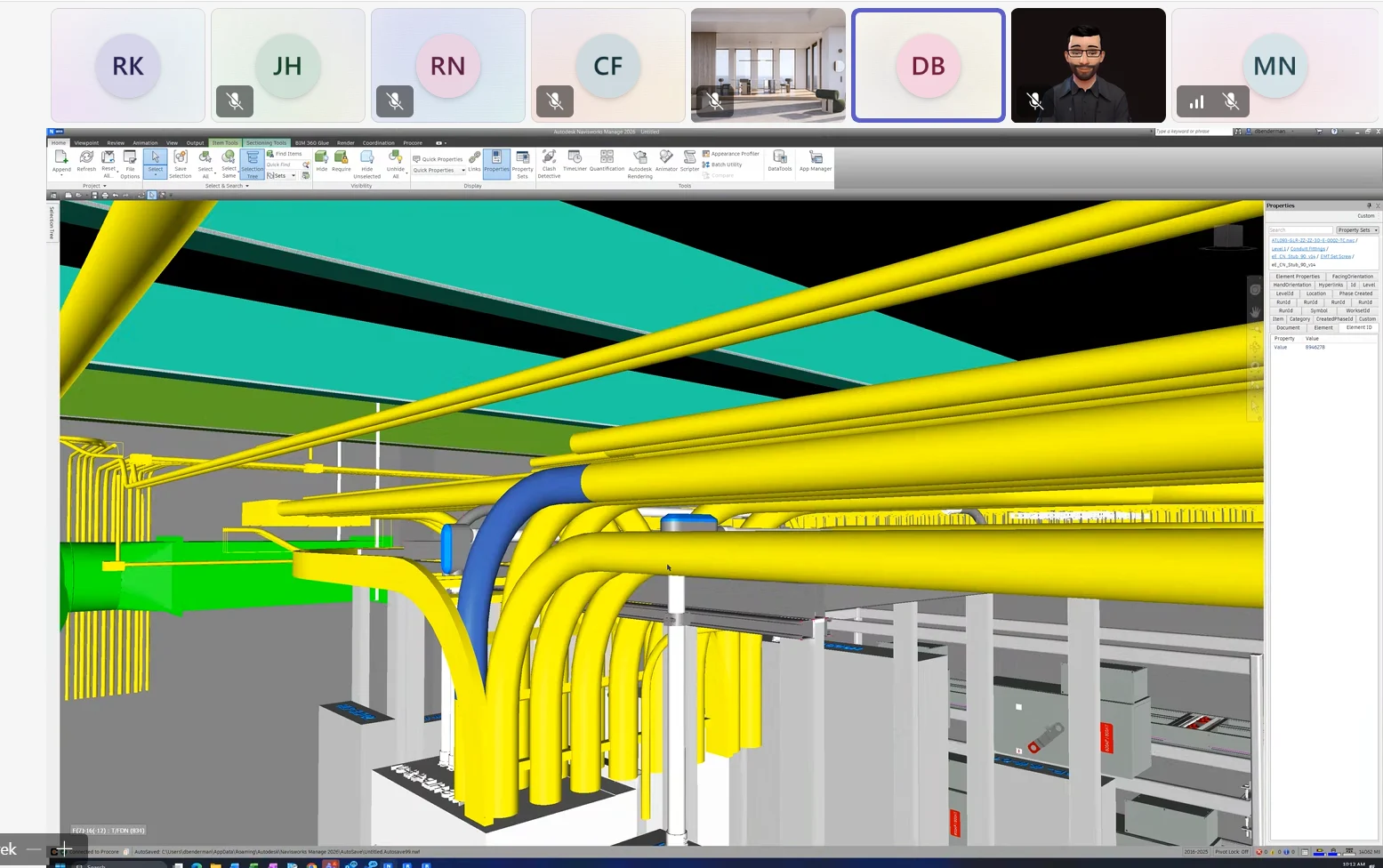
Seven people on a Navisworks call, staring at a model full of yellow conduit, blue duct and green cable tray, reading element properties out loud to figure out what changed since last week. That meeting happens two or three times a week and runs past 90 minutes. That's $2,000 to $3,000 in labour, every time. Open the export history and the diff inspector, and you get the answer in 15 minutes.
One record of the project, kept as the work happens
Four things run underneath your coordination process, all the time. None of them wait for someone to file a report.
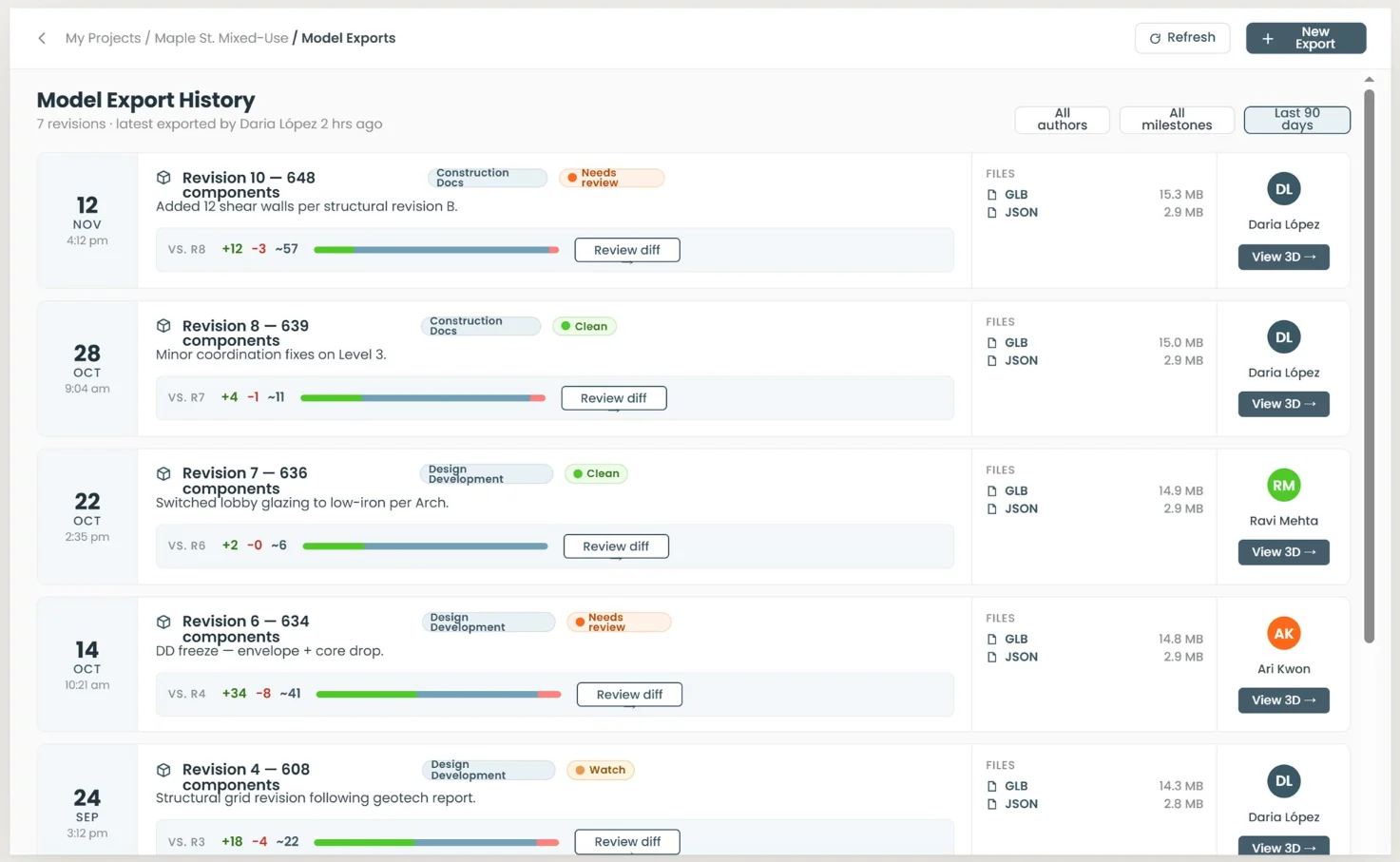
Model export history
Every export becomes a versioned snapshot with full metadata: who exported it, when, component count, model size and downloads. Sorted newest first, with milestone badges.
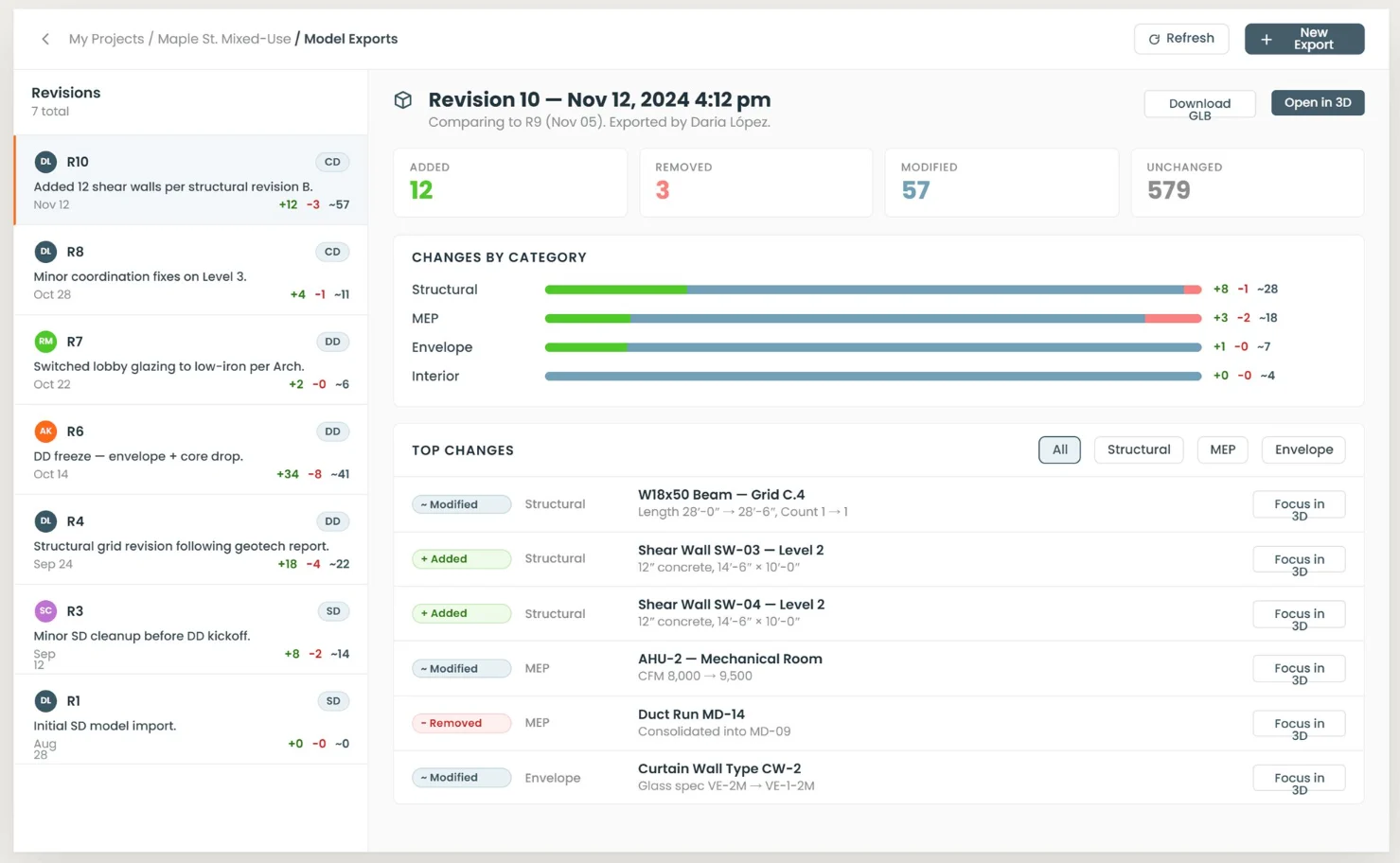
Element-level diffs
You see every change between two revisions: what's added, removed, or modified, sorted by category. Click any element to focus it in 3D.
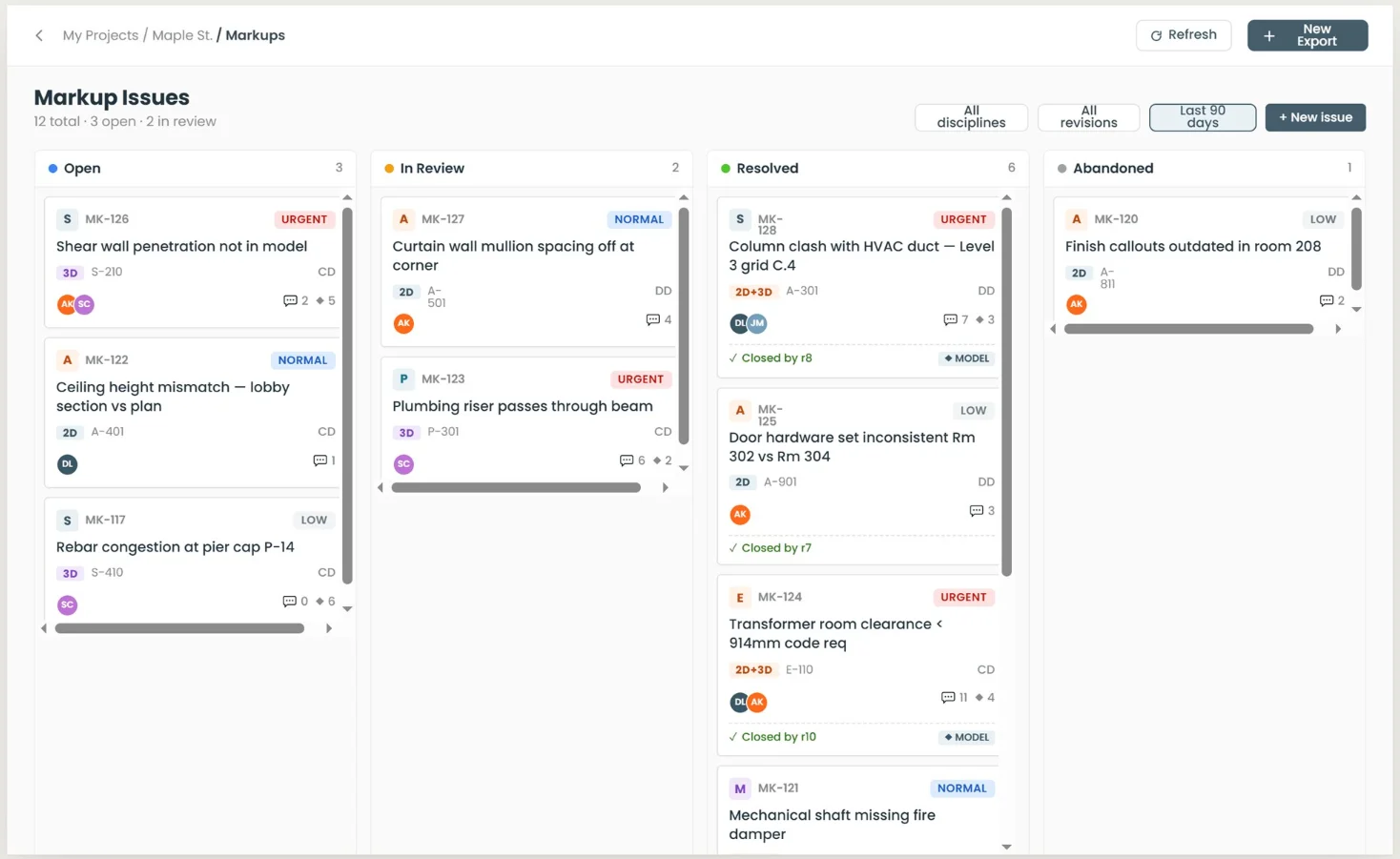
Issues pinned to geometry
Every issue attaches to a Revit element. The 3D screenshot captures itself. Assigned by trade. Tracked until it's resolved. Nothing lives in your inbox.
Team intelligence
Contribution tracking, issue resolution rates and a Problem Solver Index per person. You see who is ahead and who needs support now, not at the post-mortem.
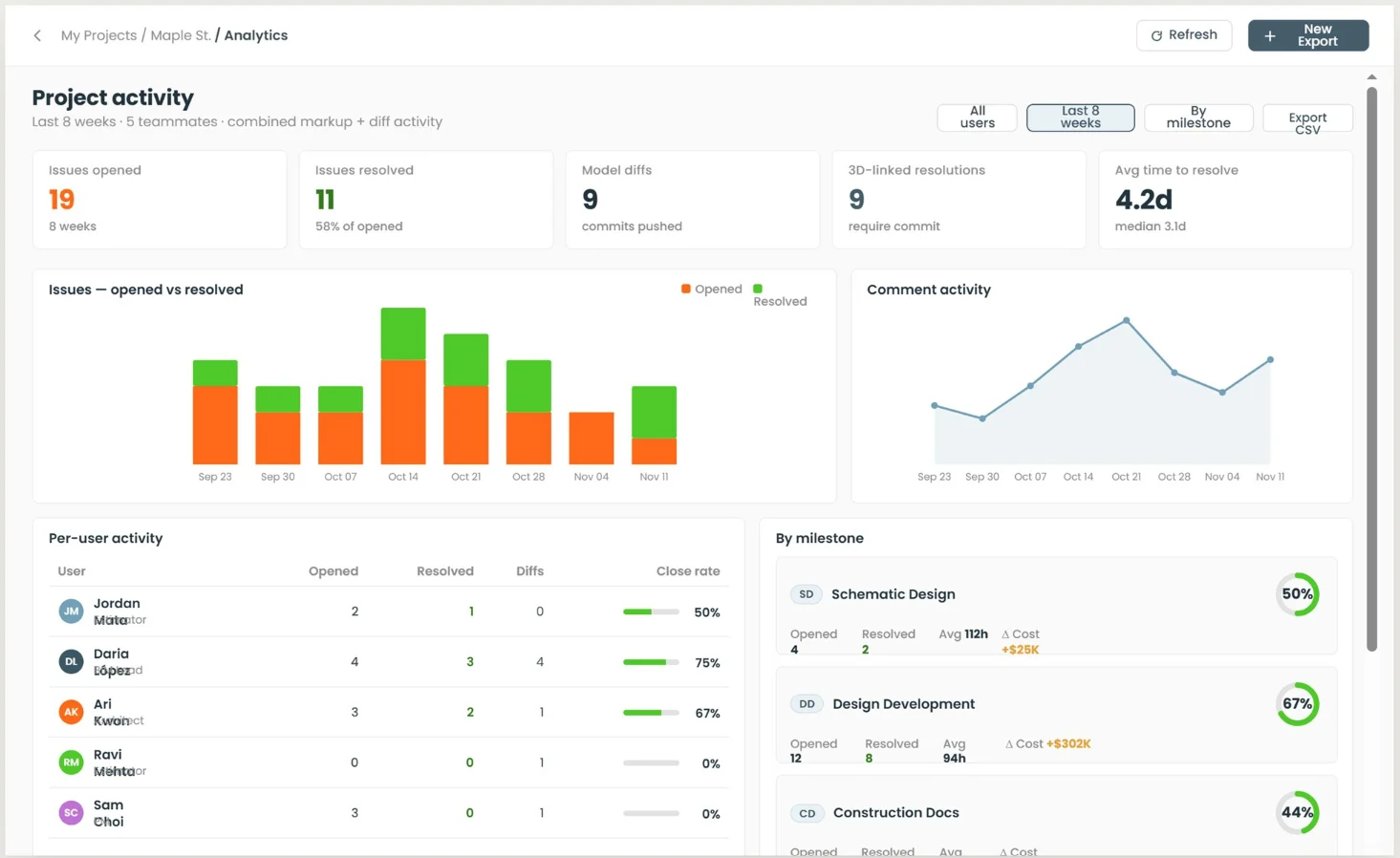
These aren't concepts. They're production features, running on active projects right now. Every one is included with your Enterprise deployment.
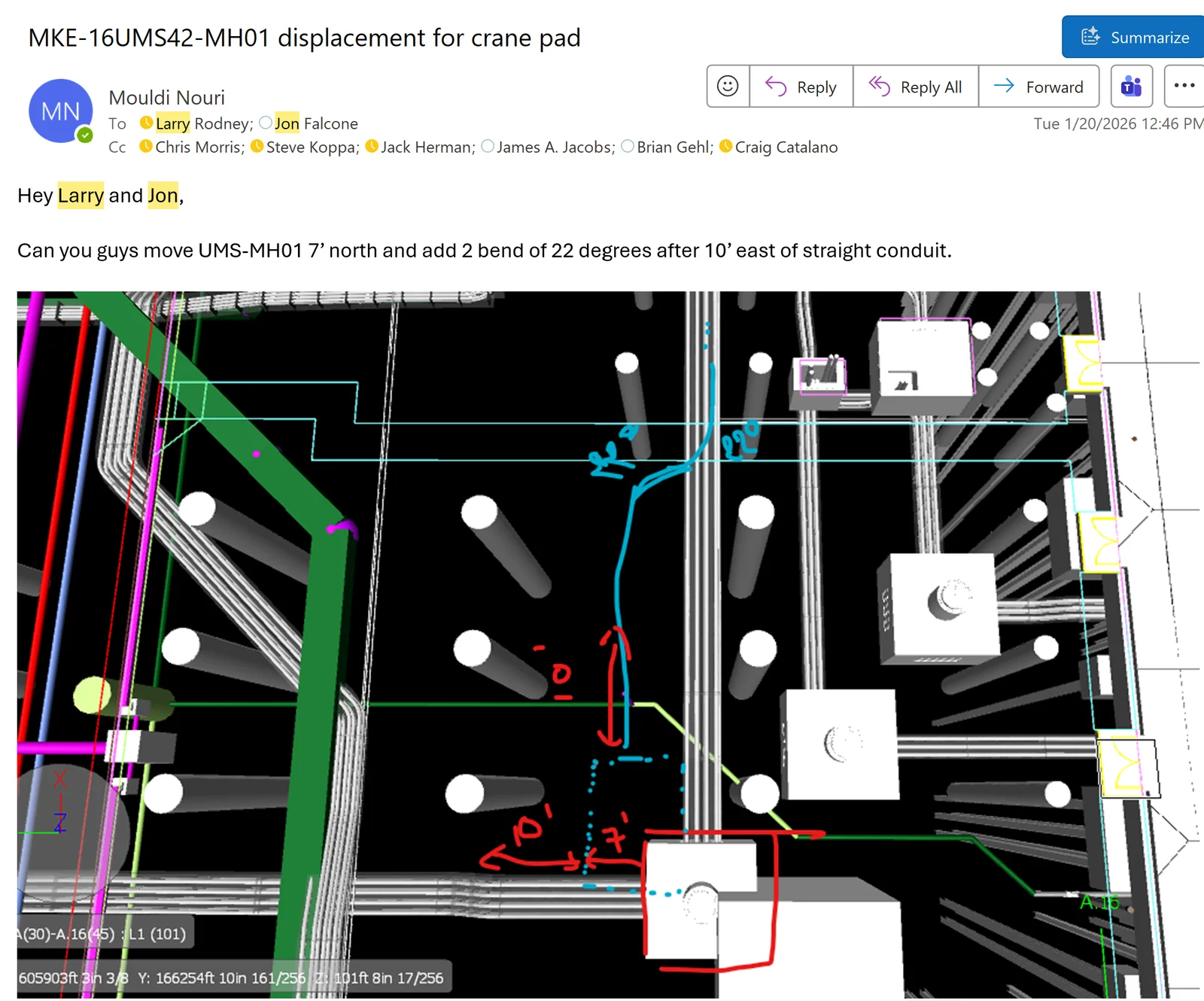
Markup and resolution in one place
Redlines, clash circles and field photographs attach to the element they concern and stay attached. The Teams thread, the expired Bluebeam session and the shared drive holding 47 versions of the same markup all collapse into one auditable record, tied to the model, the person and the resolution.
What it replaces
- Bluebeam sessions that expire
- Teams chats that get buried
- Email threads with 15 people copied in
- Shared drives with 47 versions of the same markup
Every change reviewed before it reaches the shared model
Model health checks, naming validation and clash detection run on each change before it lands. Catching a clash in the model costs $50. Catching the same clash in the field costs $5,000-$50,000.
Proven on the hardest version of the problem
Data centres pack every coordination headache into a short schedule. Hundreds of overhead conduit runs. Underground work that can't move once the slab is poured. Prefabricated skids that have to land within inches. BidLight runs the delivery process behind data centres handed over in under 8 months.
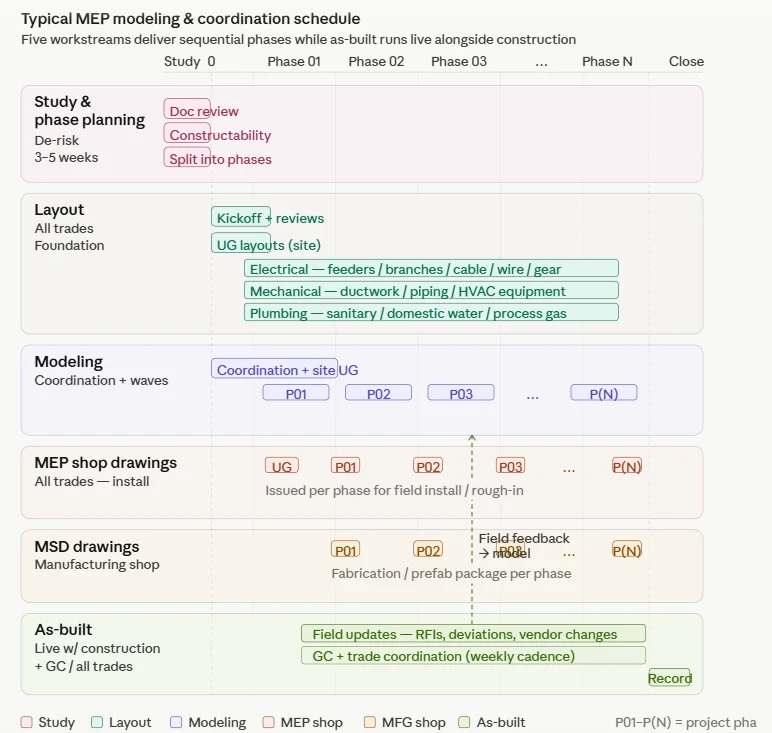
Study and phase planning
Document review, constructability and phase splitting, typically 3-5 weeks.
Layout
Kickoff, underground layouts, and trade-by-trade electrical, mechanical and plumbing routing.
Modelling
Site and underground coordination comes first. Detail rolls out phase by phase.
Shop drawings
Issued per phase for field install, with pull calculations generated from the coordinated model.
Fabrication packages
Manufacturing drawings per phase for prefabricated assemblies and skids.
As-built, live
Field updates, RFI responses and on-site clash resolutions flow straight back into your model while construction runs.
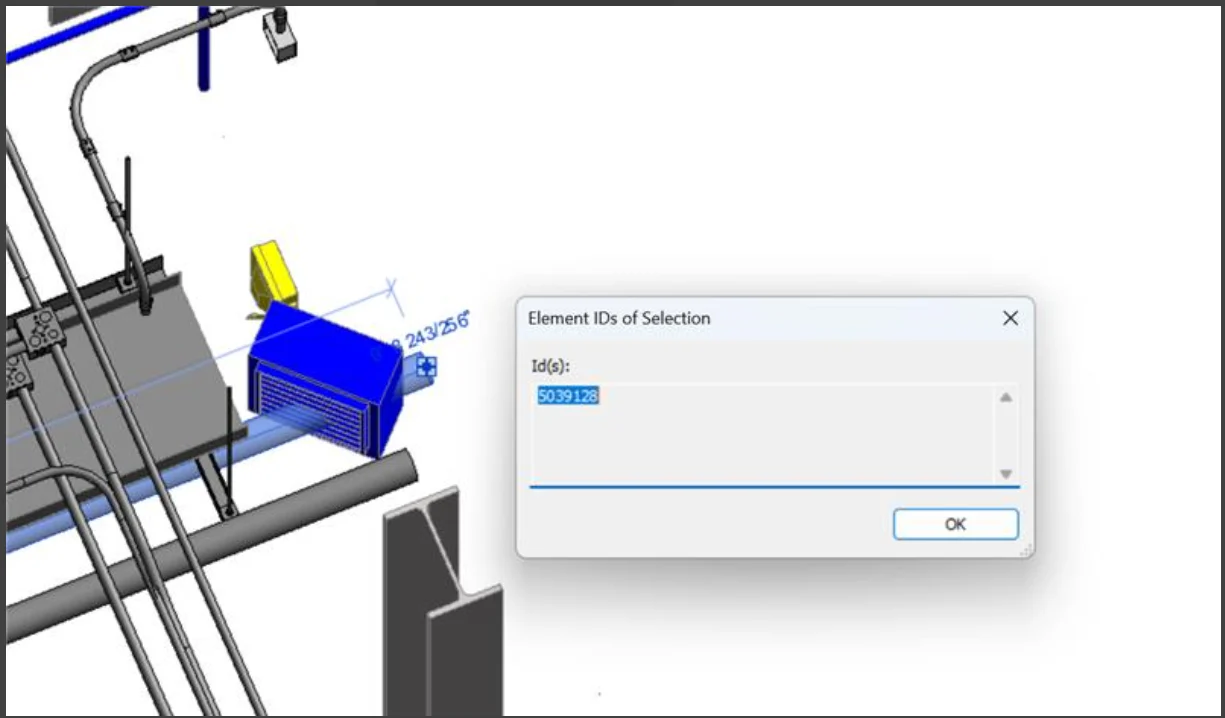
Underground is the least forgiving scope on any project. Pour the concrete, and a change costs ten times what it would have cost in the model. Every stub-up has to match the model exactly.
Cost, where it belongs
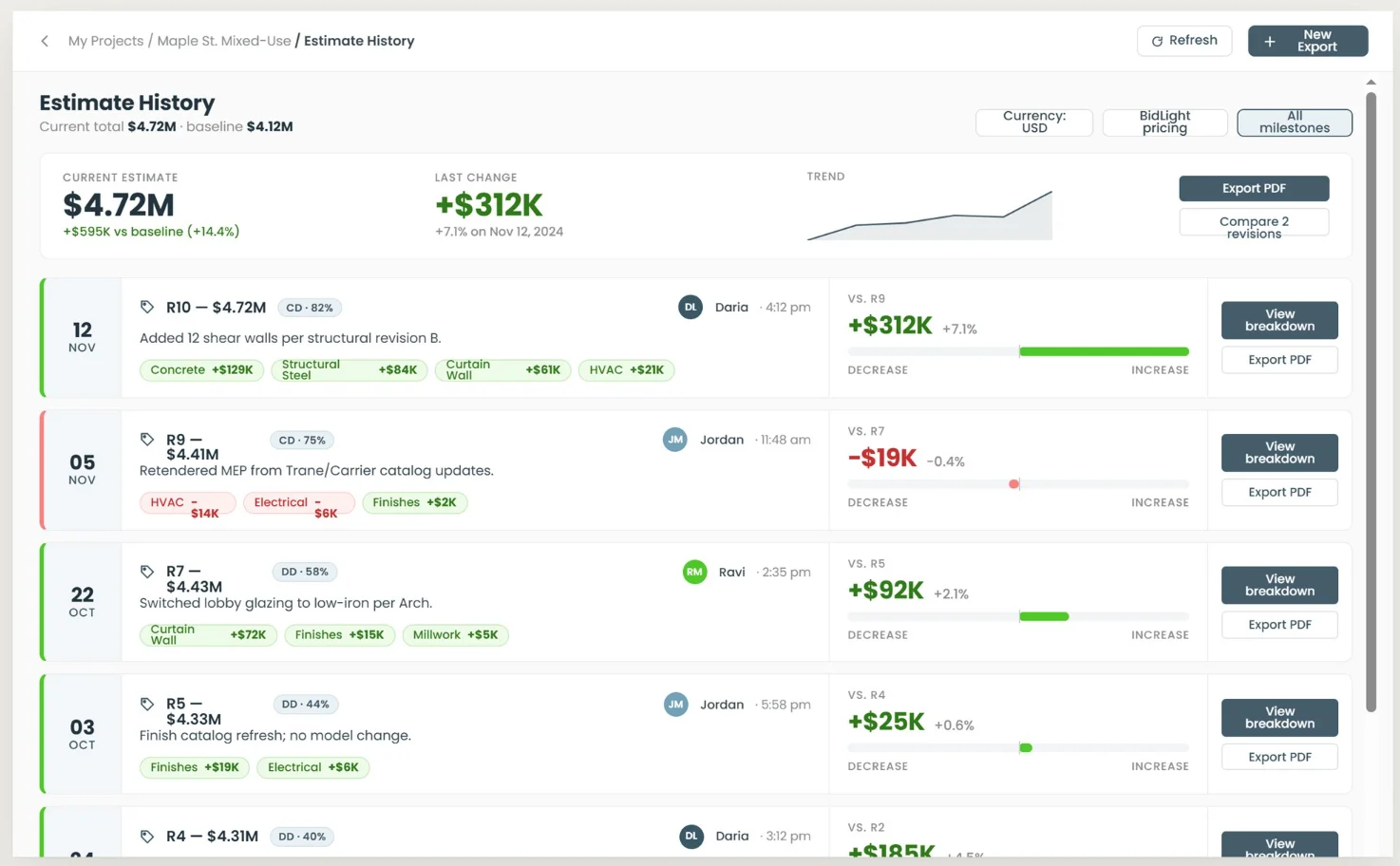
Cost follows coordination, so BidLight tracks it that way. Compare any two revisions side by side. See which line items moved, by category, by trade, and who moved them. You walk into the owner meeting with a revision-by-revision cost record, not a lump-sum surprise.
Cost management runs inside the coordination platform, on the same model. The cost engine still runs standalone if that's all you need, and our estimating team still takes the work on as a service.
Choose Your Coordination Plan
One price per licence. Every plan opens the coordination workspace; Enterprise adds the Estimation Package with unlimited licences — contact us.
Basics
For raising issues and taking part in coordination.
per licence, per month
Save $100 per licence per year with annual
- View the project and its 3D model
- Raise issues and take part in issue threads
- See who is on the project
- Email support and BidLight Learning
Best for Reviewers and Trade Partners
Core
For running issues and collaborating with partners.
per licence, per month
Save $138 per licence per year with annual
Everything in Basics, plus:
- Edit, assign, share and close issues by trade
- Model export history and element-level diffs from Revit
- Checklists and meeting minutes
- See the schedule and report progress
- Bring partner companies in; manage projects, users and roles
Best for Coordinators
Complete
For controlling the plan, reviews and documents.
per licence, per month
Save $172 per licence per year with annual
Everything in Core, plus:
- Build the plan — Gantt, milestones and schedule import
- Review Center — resolution tracking and the approval queue
- Revisions and document control
- Disciplines, filters, parameters, export settings and WBS
- Team intelligence and AI model-health suggestions
Best for BIM Managers
Max
For every coordination capability.
per licence, per month
Save $238 per licence per year with annual
Everything in Complete, plus:
- Analytics & Performance dashboards with export
- Resource, engineering and asset tracking
- Kanban, project tracking and sharing
- Reports & notifications console
- API access and custom integrations
Best for Teams That Need Every Coordination Capability
Enterprise
Everything in BidLight: the full coordination workspace and the estimation suite, for as many licences as you need.
arranged with our team
Everything in Max, plus:
- The full Estimation Package included for every licence
- Unlimited licences for one flat monthly price
- Custom integrations
- Dedicated account manager
- Invoiced billing and procurement paperwork
- 24/7 support
Best for Large Organizations
All plans include
- Access to BidLight for Revit on Windows, and BidLight on the web
- Unlimited projects — no monthly project cap on any tier
- Unlimited model exports and secure centralized storage
- AI-assisted coordination: model-health suggestions and change reports
- Technical support by email
- Full access to BidLight Learning courses
Compare Plans and Features
Buying for a large team?
Volume licensing, invoiced billing, procurement paperwork and deployment support for organizations rolling out BidLight at scale.
See it against your own model
Bring a Revit export from a live project. We'll show you the diff, the issues it would have raised, and who on your team would have had to fix them.
Request a DemoTalk to us