The Handoff Package That Ends With a Model Commit, Not a Folder on Teams
The Handoff Where the Job Goes Blind
A new superintendent starts Monday. Last time the handoff was a Teams channel, 400 emails and a Bluebeam set three revisions old. They spent the first week asking which sheet was live. That's not a handoff. That's a scavenger hunt with a schedule attached.
You know the picture. The outgoing super left a folder on Teams called 'Turnover.' Inside: a PDF set, a few marked-up screenshots, a spreadsheet of open items with no owner, and a readme that says 'ask Dave about the east riser.' Dave left in March. The new super opens the folder, sees twelve files with 'final' in the name, and picks the one with the latest date. It's still three revisions behind the model.
The cost of that confusion does not show up as a line item. It shows up as a crew standing in the corridor waiting for someone to confirm the ceiling height. It shows up as an RFI that was already answered in the model but nobody could find. It shows up as a change order because the field built from a sheet that had been superseded. A clash caught in the model costs about $50. The same clash found in the field runs $5,000 to $50,000. And an unresolved one can burn $15K to $50K a week in idle field labour. The handoff is where those numbers get decided.
The problem isn't that people don't care. It's that the record is scattered. The model lives in Revit. The issues live in a portal. The markup lives in Bluebeam. The conversation lives in Teams and email. Every handoff forces someone to reconcile four systems by hand, and the new person inherits the mess without the context. Field and office on one record fixes the handoff. That's the whole idea.
A model commit changes that. Instead of a folder, the handoff is a specific point in the model's history. Every element carries the sheet, the revision and the RFI that touched it. Redlines and 3D markups stay pinned to the element through closeout. The new lead opens the project view and sees what is installed, what is open and which commit fixed it. No digging. No version roll call. That is construction management from study to closeout, with phases and deliverables tracked against the schedule, and field and office reading from the same page.
What a Model Commit Handoff Looks Like
Picture the Monday morning. The new super opens the project view. The first thing on screen isn't a file tree. It's the current model state: what's installed, what's open, what changed since the last commit. They click the east riser. The element opens with its history. The sheet that shows it. The revision that moved it. The RFI that asked about it. The clash that was pinned to it and closed with proof. They don't have to ask Dave. Dave's knowledge is in the record.
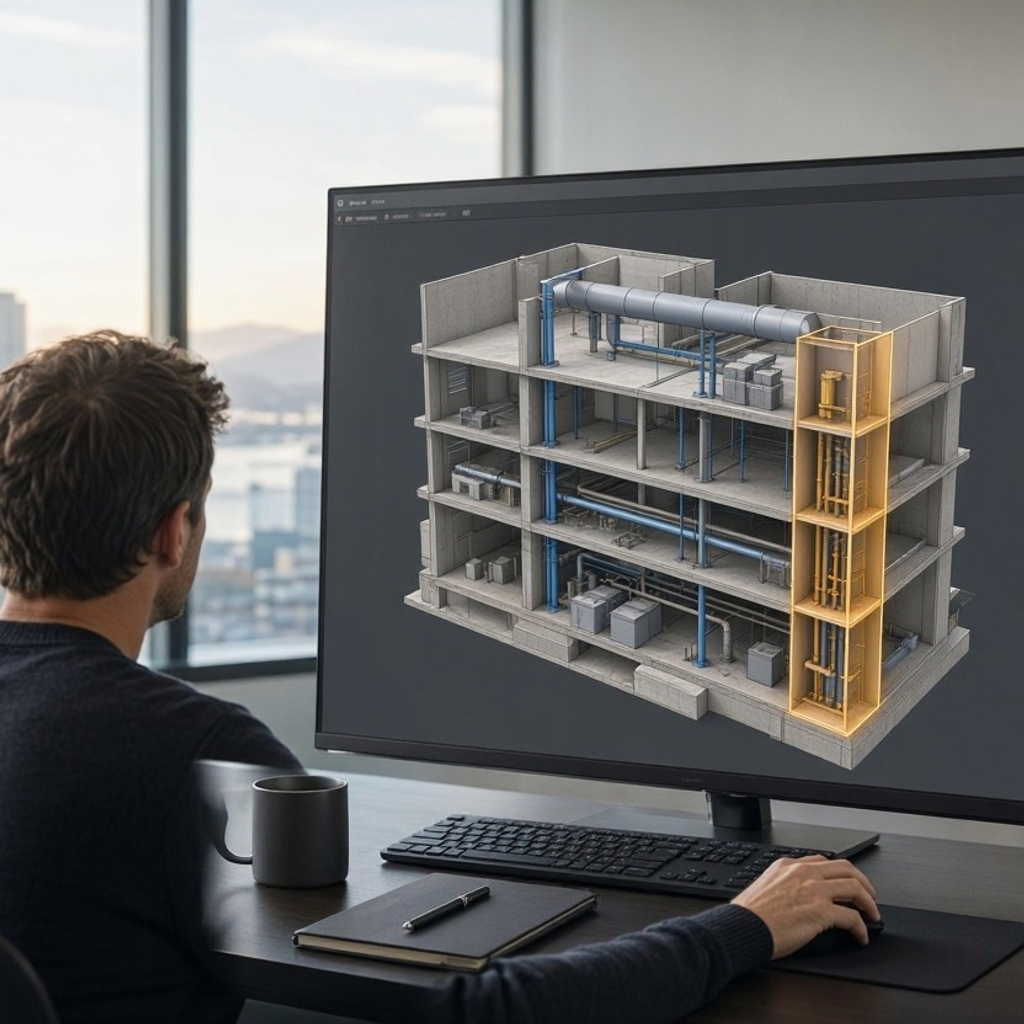
That's the difference between a folder and a commit. A folder is a snapshot of files. A commit is a point in the model's life with a diff attached. BidLight versions every Revit and Navisworks export and compares it element by element. So the handoff package isn't a zip file. It's a commit reference. The new super can see exactly what changed between the last two exports, by category, with the author and the milestone on it. They see the 15-minute diff instead of sitting through a 90-minute coordination meeting. That's not a productivity tweak. That's a week of ramp-up time back.
The other thing a commit handoff gives you is proof. Every issue is pinned to the element it concerns and closes only with proof. So when the new super looks at a wall penetration, they see the clash, the fix, the photo, the sign-off. They don't have to trust a spreadsheet that says 'closed.' They can see the record. That matters when the owner asks why the mechanical room is behind. You're not reconstructing history from memory. You're reading it from the model.
And it carries the cost. Each revision shows its cost impact by category and by trade, with the person who made the change. So the new super does not just see what changed. They see what it cost. They see the drift against the baseline before the owner meeting, not at the post-mortem. That's cost control tied to the model, not a separate spreadsheet that's already stale. The handoff package becomes a cost record as much as a construction record.
Why the Old Handoff Keeps Failing
The old handoff fails for a simple reason: it asks people to reconcile versions by hand. The model is at revision 12. The PDF set is at revision 10. The issue log was last updated on Thursday. The RFI log lives in a different system. The new super has to figure out which one is live. That's a 90-minute meeting before they can even start. And a 90-minute coordination meeting costs $2,000 to $3,000 in labour. You pay that before the new person has asked a single question.
The deeper failure is that the record does not travel with the work. A redline on a sheet does not know which element it belongs to. A 3D markup in Navisworks does not know which RFI it answers. A Teams message does not know which revision it refers to. So every handoff is a translation exercise, and every translation loses something. The new super spends the first week asking which sheet is live because the record never answered the question in the first place.
That's also where idle labour starts. If the field is waiting on a confirmation that's already in the model, you're paying for standing time. The brand numbers are blunt: $15K to $50K a week in idle field labour behind an unresolved clash. The handoff is where those unresolved clashes hide, because nobody pinned them to the element and nobody closed them with proof. A folder on Teams can't fix that. A commit can.
Field and office on one record fixes the handoff because it removes the translation step. The field person and the office person are looking at the same element, the same revision, the same RFI. There's no version roll call because there's only one version that matters: the current commit. That's what construction management looks like when it's built on the model the team already works in.
The Cost of a Bad Handoff, in Numbers You Recognize
You don't need a new metric to see the cost. You already have the numbers. A clash caught in the model costs about $50. The same clash found in the field costs $5,000 to $50,000. An unresolved clash burns $15K to $50K a week in idle field labour. A 90-minute coordination meeting costs $2,000 to $3,000 in labour, and a 15-minute diff replaces it. Those aren't projections. They're the arithmetic of a handoff that goes blind.
Now add the ramp-up. A new superintendent who spends a week asking which sheet is live is a superintendent who isn't running the job. That's a week of decisions delayed, a week of RFIs stuck, a week of the schedule slipping quietly. On a data center job, where 9 in 10 projects overrun schedule, that week matters. It's not just the salary. It's the crew waiting, the inspector waiting, the owner asking why the look-ahead hasn't moved.
The handoff also determines how much rework you eat. If the new super builds from a sheet that's three revisions old, you're redoing work that was already coordinated. That's the $5,000 to $50,000 clash showing up as a field fix. And it's avoidable. If the handoff is a model commit, the field builds from the current commit, not a PDF that was printed last month. The record answers the question before the crew asks it.
The bigger number is trust. A handoff that works tells the owner you have the job under control. A handoff that fails tells them you don't. That's the owner relationship, and it's the thing you protect on every job. A model commit handoff gives you something to show. Not a folder. A record. That's what you bring to the meeting when the owner asks how the transition is going.
How to Make the Switch Without Blowing Up the Schedule
You don't have to change everything at once. Start with the next handoff. Before the new super starts, pick the commit you want them to inherit. Make sure it's the current one, with the diff attached. Then open the project view with them. Show them the element history, the pinned issues, the cost impact per revision. That's a 15-minute walkthrough instead of a 90-minute meeting. And it gives them the record they'll use every day.
The second step is to stop treating the folder as the record. The folder can still exist. But the handoff package is the commit reference. That means every redline and 3D markup gets pinned to the element, not dropped in a PDF. Every issue closes with proof, not a status change. Every RFI gets linked to the revision it touched. That's not extra work. It's the work you're already doing, captured in the model instead of scattered across Teams, email and Bluebeam.
The third step is to make the diff the first agenda item. When the new super sits in their first coordination meeting, they should not be getting a recap. They should be looking at what changed since the last commit. That's the 15-minute diff. It tells them where the job is moving, who's behind, which clash is still open. That's risk management while there's still schedule left to recover. Not a post-mortem. A live view.
None of this requires a new platform for the field or a new portal for the office. It runs inside Revit and Navisworks, the tools the team already uses. BidLight versions every export, diffs it element by element, pins issues to the element and closes them with proof. The handoff becomes a commit. The record travels with the work. And the new super starts Monday with the job in front of them, not a folder.