
Why Issue Resolution Lacks Accountability in Data Center Projects
In data center construction, issue resolution rarely fails because teams do not see the problem. It fails because too many people see the problem without a clear owner, a defined decision path, or a measurable consequence for delay. In mission-critical environments, where power distribution, cooling pathways, containment, controls, fire protection, and structural constraints compete for the same physical space, unresolved issues do not stay isolated. A small routing conflict can affect feeder lengths, breaker coordination, busway access, prefabrication sequencing, commissioning schedules, and ultimately the facility’s ability to go live on time. The problem is not only technical complexity. It is the lack of accountability built into how issues are identified, assigned, tracked, and closed.
Accountability Breaks Down Before the Issue Is Even Assigned
Many project teams assume accountability starts when an issue is formally logged. In reality, it starts earlier, when the issue is first discovered in the model, during coordination, in the field, or inside a design review. Data center projects generate thousands of comments, markups, RFIs, coordination notes, and trade-level observations. Without a structured process, these signals spread across meetings, emails, spreadsheets, BIM views, and chat threads.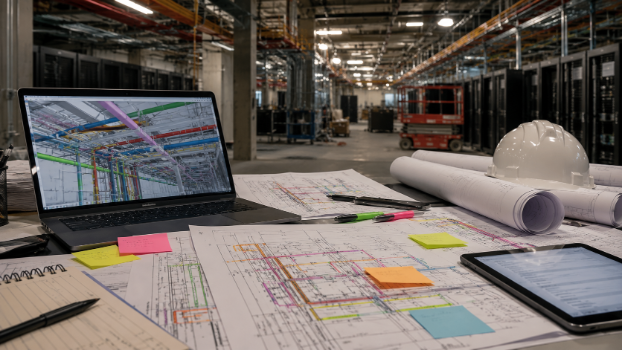
When issue discovery is fragmented, ownership becomes unclear from the beginning. A clash between a cable tray and a chilled water line may appear to be a coordination issue, but the root cause could involve electrical clearance, mechanical routing priority, structural steel placement, or access requirements for maintenance. If the issue is not classified correctly, it gets passed around instead of resolved.
The “Everyone Saw It” Problem
One of the most common accountability failures in data center projects is shared visibility without assigned responsibility. Everyone can see that an electrical room is becoming congested. Everyone can see that feeders are being rerouted too often. Everyone can see that a corridor rack no longer aligns with the prefab plan. But visibility alone does not create action.
In high-density environments, teams often mistake awareness for accountability. A clash appears in a model review, several people discuss it, and the meeting moves on with a vague assumption that “the trades will coordinate.” That phrase is dangerous. It sounds collaborative, but it often means no individual or team has been clearly assigned to make a decision, update the model, confirm downstream impact, and verify closure.
Multi-Trade Dependencies Make Ownership Difficult
Data center infrastructure is deeply interconnected. Electrical decisions affect mechanical access. Mechanical routing affects structural openings. Fire protection affects ceiling zones. Controls and telecom pathways compete with power distribution. This level of dependency makes ownership harder than in simpler building types.
A single issue may require input from several stakeholders, but that does not mean accountability should be shared equally. Shared input is not the same as shared ownership. When ownership is diluted across multiple trades, each party waits for another team to move first. The result is delay, rework, and repeated discussion of the same issue in multiple coordination meetings.
Electrical Systems Expose the Weakness Fast
Power infrastructure often reveals accountability gaps earlier than other scopes because electrical systems have strict spatial, safety, and operational requirements. Medium-voltage gear, transformers, switchgear, UPS systems, bus duct, conduit banks, and cable trays cannot simply be shifted without consequences. Clearance, heat dissipation, bend radius, pull access, serviceability, and code compliance all matter.
When an electrical routing issue is treated as a simple clash, teams underestimate its impact. Moving a bus duct can affect support framing, access panels, equipment alignment, feeder lengths, and commissioning assumptions. If no one owns the full impact review, the model may look resolved while the constructability risk remains alive.
Coordination Meetings Often Create Discussion, Not Closure
Coordination meetings are essential, but they are not accountability systems by themselves. Many data center projects hold frequent coordination sessions, yet still suffer from unresolved issues because meetings become a place for discussion rather than decision-making.
A productive meeting should clarify the issue, assign ownership, define the required action, set a deadline, and confirm how closure will be verified. Too often, meetings end with notes that lack enough specificity. “Electrical to review,” “mechanical to adjust,” or “GC to confirm” are not strong accountability statements. They do not define what needs to happen, who is responsible for the final decision, or what proof is required to close the issue.
Repeated Issues Signal Process Failure
When the same issue appears in multiple meetings, the technical problem is usually no longer the main problem. The real problem is process failure. Either the owner was not clear, the decision path was incomplete, the impact was not understood, or the closure standard was weak.
Repeated issues are especially costly in fast-track data center projects because construction often advances while coordination is still being refined. If the field team proceeds based on an outdated model or unresolved assumption, the cost of correction increases quickly. What could have been a model adjustment becomes a procurement issue, a prefab change, a field rework order, or a commissioning delay.
Model Updates Do Not Always Equal Issue Resolution
A major accountability gap appears when teams treat model updates as final resolution. Updating a BIM model is important, but it is only one part of closing an issue. A model change must be checked against design intent, trade coordination, installation feasibility, prefab constraints, cost impact, schedule impact, and field readiness.
In data center projects, this distinction is critical. A conduit route may be moved in the model and no longer clash with ductwork, but the revised path may create excessive bends, conflict with access zones, or break the planned installation sequence. A cable tray may be shifted above the ceiling, but the change may reduce working clearance or interfere with future expansion pathways.
Closure Requires Verification, Not Assumption
True issue closure requires proof. The responsible team must confirm that the updated model works technically, the affected trades have accepted the change, and the field or prefab team has the latest information. Without verification, issue logs become misleading. They may show a high closure rate while unresolved risk continues moving through the project.
This is where many teams lose control. They measure whether an item was marked complete, not whether the underlying risk was removed. In mission-critical construction, that difference matters. A closed issue that was never properly verified can resurface later as a failed inspection, blocked access path, delayed energization, or late-stage commissioning conflict.
Accountability Fails When Data Is Not Connected
Data center projects produce massive amounts of project information, but that information is often disconnected. The model may show one version of the issue. The RFI log may show another. The meeting minutes may contain a different action item. The field team may be working from a drawing set that does not reflect the latest coordination decision.

When project data is disconnected, accountability becomes difficult to enforce. Teams can debate what was decided, when it was decided, who approved it, and whether the latest information was issued. This creates room for uncertainty, and uncertainty weakens accountability.
Traceability Changes the Conversation
Traceability is one of the strongest tools for restoring accountability. Teams need to know who raised the issue, who owned it, what decision was made, what changed in the model, who reviewed the change, and when the issue was verified. This creates a clear record that reduces confusion and prevents issues from disappearing into informal communication.
Traceability also improves behavior. When teams know actions are visible and measurable, they respond differently. Decisions become more disciplined. Follow-up becomes more consistent. Owners are less likely to delay action because responsibility is no longer hidden inside a group discussion.
The Real Fix Is Operational Discipline
Accountability in data center issue resolution does not come from more meetings or longer issue logs. It comes from operational discipline. Every issue needs a clear owner, a priority level, a due date, an impact category, a decision path, and a verification standard. The process must separate technical input from final ownership, and it must connect coordination decisions to model updates, field execution, and closeout evidence.
This is especially important for GCs and subcontractors working under aggressive schedules. Data center projects move too quickly for vague coordination. When teams rely on informal follow-up, unresolved issues compound. When they enforce ownership and traceability, issues become manageable, measurable, and far less likely to disrupt construction.
Accountability Is a Delivery Advantage
The best data center teams do not resolve issues faster because they have fewer problems. They resolve issues faster because they know exactly who owns each problem, what decision is required, and what proof is needed to close it. That clarity reduces rework, protects the schedule, and gives leadership better visibility into project risk.
In mission-critical construction, accountability is not administrative overhead. It is a core delivery function. The teams that treat issue resolution as a controlled technical workflow, not a loose coordination activity, are the teams that keep complex infrastructure moving without losing control.