
Why GCs Struggle to Track Issue Ownership in BIM Projects
General contractors rarely struggle because they cannot find BIM issues. They struggle because too many issues sit between systems, trades, and decisions without clear ownership. In a data center BIM environment, that gap is expensive. A conduit conflict is not just a conduit conflict when it affects power distribution, cooling airflow, maintenance access, redundancy, or future expansion. The real challenge is turning clash detection into accountable issue management, where every tracked issue has an owner, a due date, technical context, and a verified closeout path.
Why Issue Ownership Breaks Down in BIM Projects
Issue ownership breaks down when the model shows a problem but the workflow does not define who is responsible for resolving it. A general contractor may see a clash between electrical systems and mechanical systems, but the fix may require input from trade contractors, engineers, and field supervisors.
The Difference Between Detecting an Issue and Owning an Issue
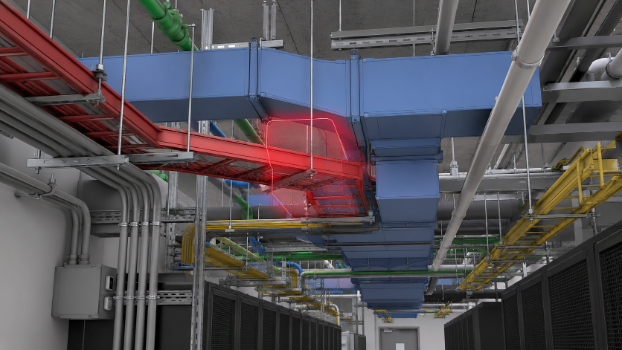
Clash detection identifies interference. Ownership defines accountability. If a cable tray crosses a duct bank, Navisworks or Revit can expose the conflict, but the model alone will not decide whether electrical reroutes, mechanical adjusts, or the design team revises the layout.
Why Coordination Meetings Alone Are Not Enough
Coordination meetings often create verbal alignment without durable tracking. A team may agree that a trade owns the fix, but without tracked issues, owners and due dates, and model-based comments, the same item returns week after week.
How Unclear Responsibility Leads to Field Rework
When issue management is weak, design conflicts become RFIs, change orders, inspection delays, and rework. In mission-critical facilities, those delays can affect power systems, cooling systems, and commissioning sequences.
The Role of BIM Coordination in GC Accountability
BIM coordination should give the GC visibility across models, systems, and trade responsibilities. The goal is not only to aggregate geometry, but to create clear lines of responsibility from discovery to closeout.
BIM Execution Plan as the Foundation for Responsibility
A strong BIM execution plan defines model update frequency, clash rules, coordination hierarchy, escalation steps, and ownership logic. Without it, every issue becomes a negotiation instead of a controlled workflow.
Common Data Environment and Model-Based Tracking
A common data environment helps teams manage issue management in one place. It connects viewpoints, comments, status, owners, due dates, and model revisions so the GC is not chasing screenshots across email chains.
Clash Ownership Matrix for Trade Responsibility
A clash ownership matrix is especially useful in dense MEP coordination. It clarifies whether electrical, mechanical, plumbing, structural, or fire protection teams own specific conflict types.
Why Data Center BIM Makes Issue Ownership Harder
Data center BIM raises the stakes because systems are dense, redundant, and operationally sensitive. Small coordination misses can affect uptime, availability, reliability, and maintenance access.
Dense MEP Coordination Across Multiple Trades
Mechanical systems, electrical systems, plumbing systems, cable trays, conduits, and cooling distribution often compete for the same ceiling zones and service corridors. A GC must understand both the physical conflict and the operational consequence.
Electrical Infrastructure as the Highest-Risk Coordination Layer
Electrical infrastructure is one of the most critical layers. Switchgear, transformers, bus ducts, feeders, branch circuits, PDUs, RPPs, UPS systems, and server racks must be coordinated with exact routing, clearance, and access requirements.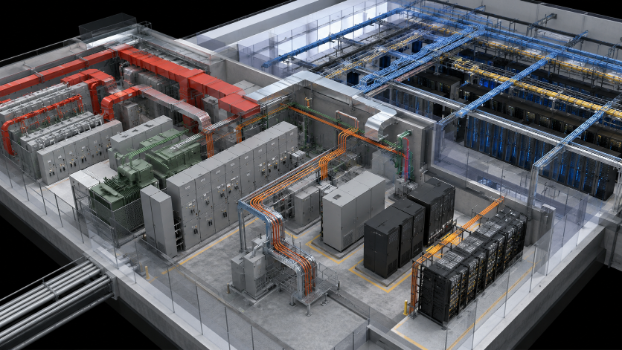
Cooling Systems and Electrical Routing Conflicts
Cooling systems create another layer of complexity. HVAC, chillers, chilled water systems, CRAC units, airflow, hot aisle, cold aisle, and hot/cold aisle strategies must work alongside electrical routing without blocking service access.
Power Infrastructure and Redundancy Ownership
In data centers, a clash can affect more than installation. It can weaken redundancy, create a single point of failure, or compromise failover logic.
Utility Power, Switchgear, and Distribution Pathways
Power distribution begins with utility feeds and moves through switchgear, transformers, UPS systems, PDUs, RPPs, and server racks. If one pathway is poorly coordinated, it can affect capacity, inspection, and long-term maintainability.
UPS Systems, Backup Generators, and ATS Coordination
UPS systems, uninterruptible power supply equipment, backup generators, generator sets, automatic transfer switches, ATS, battery backup, battery racks, and battery management systems all require precise access, ventilation, replacement clearances, and coordinated routing.
A/B Power Paths and Dual Power Path Responsibility
A/B power paths must remain separated and independently maintainable. If A-side and B-side routing are compromised by poor coordination, the facility may lose the practical benefit of dual power paths.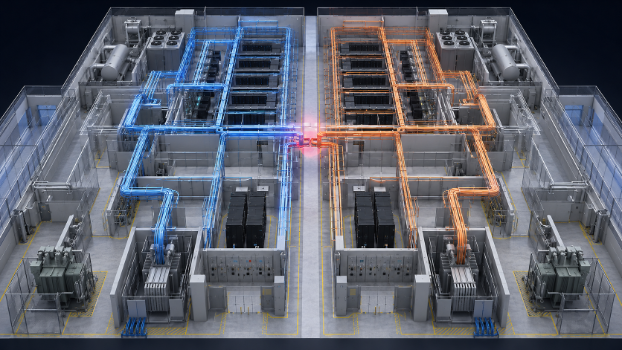
Redundancy Models: N, N+1, N+2, 2N, and 2N+1
Redundancy models define how much spare or duplicated capacity exists. N+1 redundancy adds backup capacity. 2N redundancy duplicates the full system. 2N+1 and distributed redundant topologies add even more resilience, but they also require stricter BIM coordination.
Fault Tolerance, Failover, and Concurrent Maintenance
Fault tolerance depends on clean separation, accessible equipment, and reliable failover. Concurrent maintenance is impossible if service access, clearance validation, or isolation pathways are blocked by unresolved BIM issues.
How Issue Ownership Affects Uptime and Tier Expectations
Uptime is shaped during construction, not only during operations. Poorly owned coordination issues can create hidden operational risks long before the facility goes live.
Why Uptime Depends on Construction-Level Decisions
A misrouted bus duct, blocked valve, inaccessible UPS cabinet, or compromised cooling path can reduce availability. Reliable facilities need issue ownership that protects both construction delivery and operations.
Tier III and Tier IV Coordination Implications
Tier III and Tier IV expectations require stronger resiliency, redundancy planning, concurrent maintenance, and fault tolerance. GCs need traceable decisions for every system that supports uptime.
Tools and Workflows GCs Use to Track BIM Issues
Tools help, but workflows decide outcomes. Revit, Navisworks, model aggregation, and issue platforms only work when teams convert model findings into accountable actions.
Revit and Navisworks in Coordination Workflows
Revit supports design and fabrication modeling. Navisworks supports clash detection and coordination review. The gap appears when clashes remain reports instead of assigned, trackable issues.
From Clash Reports to Trackable Issues
Raw clash reports are too noisy. GCs need grouped issues with system context, owners and due dates, viewpoints, priorities, and closeout evidence.
Prioritizing Issues by Risk, Not Just Quantity
Not all clashes matter equally. A conflict affecting power distribution, redundancy, cooling efficiency, NEC compliance, or maintenance access deserves more attention than a low-impact clearance issue.
Field Execution, Prefabrication, and Installation Risk
Issue ownership becomes more expensive once work moves from model to field. At that stage, errors affect labor, materials, inspections, and schedule.
LOD 400 and Fabrication-Ready Models
LOD 400 fabrication models require high confidence. Electrical skids, conduits, cable trays, bus ducts, and modular infrastructure cannot be fabricated correctly if ownership is unresolved.
Prefabrication Workflows and Modular Infrastructure
Prefabrication workflows depend on approved models. Late changes to electrical skids or modular assemblies can trigger remanufacturing, field modification, and rework.
Phased Deployment and Future Expansion
Many data centers are built in phases. Poor issue tracking can block future expansion, spare pathways, phased installation, or future service access.
Operational Handover and Long-Term Facility Management
BIM issue ownership should not end at installation. It should support accurate as-built models, monitoring, facility management, and operational efficiency.
As-Built Models and Digital Records
If field changes are not tied back to tracked issues, the digital record becomes unreliable. Accurate as-built models require disciplined closeout.
Monitoring, Maintenance, and Service Access
Facility management systems depend on correct equipment locations, access clearances, and system relationships. Poor construction tracking becomes an operations problem later.
Sustainability, Efficiency, and Modern Data Center Priorities
Modern data centers must balance uptime with energy efficiency, energy consumption, carbon footprint, and environmental sustainability.
Energy Efficiency and PUE
PUE is influenced by cooling efficiency, airflow, load distribution, and equipment placement. Coordination mistakes can increase energy waste.
Load Distribution and Circuit Validation
Electrical load distribution, load balancing, circuit validation, and NEC compliance must be coordinated early to avoid inspection issues and capacity problems.
Battery Technology and Backup Innovation
Lithium-ion batteries, VRLA batteries, battery management systems, and battery backup introduce new coordination needs, including cooling, safety, and thermal runaway prevention.
Renewable Energy and Carbon Reduction
Renewable energy sources and power management strategies are becoming part of data center planning. BIM coordination must support these sustainability goals.
What GCs Need From a Better Issue Ownership Workflow
GCs need one source of truth where every issue has context, ownership, priority, and closeout history.
Clear Ownership From the Start
Every tracked issue should have an owner, due date, escalation path, and responsible trade.
System-Based Risk Classification
Issues should be ranked by system impact: power, redundancy, cooling, maintenance access, inspection, and phasing.
Closed-Loop Issue Tracking
An issue is not closed until the model is updated, the owner confirms the fix, and the GC verifies the downstream impact.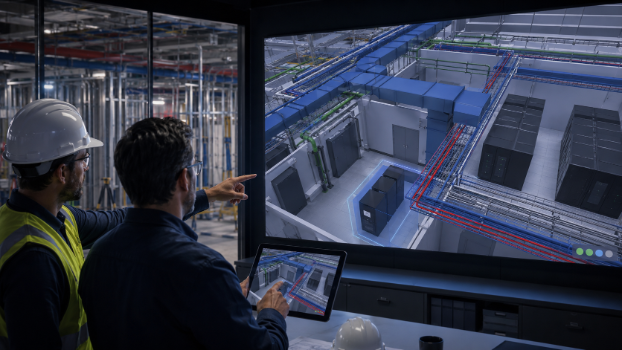
Future Trends in BIM Issue Ownership for Data Center Projects
The next generation of data center BIM will connect issue management, monitoring, facility management systems, and predictive coordination.
AI-Assisted Clash Grouping and Ownership Assignment
AI can help group clashes and suggest likely owners, but accountability still requires human review.
Digital Twins and Operations-Ready BIM
Digital twins depend on accurate as-built models and trustworthy issue histories.
Smarter Coordination for High-Density Infrastructure
As high power densities increase, GCs will need tighter control over power management, cooling efficiency, redundancy planning, and sustainability.
Conclusion: Issue Ownership Is the Missing Link in BIM Coordination
GCs do not struggle because they lack clash data. They struggle because issue ownership is often unclear. In data center BIM, the winning workflow is not just finding issues faster, but knowing exactly who owns them, why they matter, and when they are truly resolved.