Why GCs Still Rely on Manual Coordination Systems
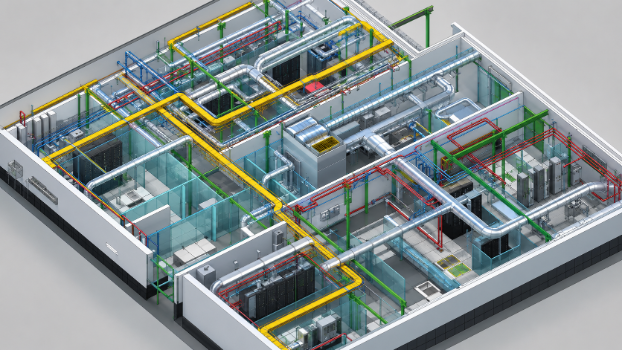
Data center construction has outgrown the old coordination habits that many general contractors still depend on. Spreadsheets, email threads, marked-up PDFs, and weekly coordination meetings can feel manageable at the start of a project, but they become fragile when power infrastructure, cooling systems, network pathways, fire protection, and redundant MEP systems begin competing for the same physical space. In mission-critical facilities, coordination is not just about avoiding clashes. It protects uptime, commissioning certainty, cost control, and long-term operational reliability.
Why Manual Coordination Still Exists in Modern Construction
Manual coordination survives because it is familiar. Most contractors, subcontractors, and trade contractors already know how to work through spreadsheets, document control folders, and meeting notes. These systems are easy to start and require little training.
The problem is that they do not scale well. As construction schedules tighten and design changes multiply, disconnected records create uncertainty. One missed revision can trigger RFIs, field issues, rework, delays, and change orders.
The Comfort of Familiar Tools
Spreadsheets give teams a quick way to track issues, owners, and dates. Emails create a visible communication trail. PDFs are easy to mark up and share. For smaller construction projects, this can be enough.
But in data center construction, familiar does not mean reliable. A spreadsheet cannot show whether a cable tray routing change affects ductwork clearance, UPS access, or cooling airflow.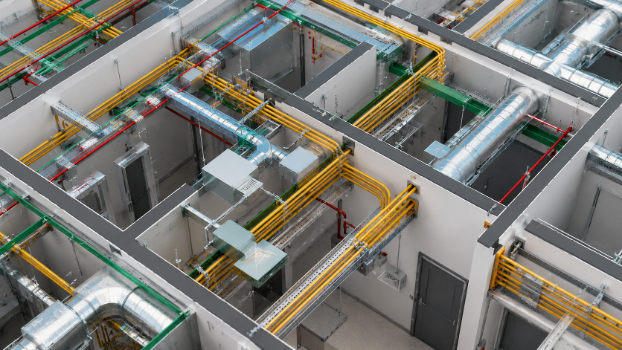
Why Manual Systems Break Down on Complex Projects
Manual coordination fails when updates are not connected to the model, schedule, and field condition. Electrical, mechanical, plumbing, HVAC, and fire protection systems evolve at the same time, but manual tools often treat them as separate conversations.
That creates coordination errors. Design conflicts stay hidden until installation. By then, the cost is no longer just a design adjustment. It becomes labor downtime, procurement impact, schedule resequencing, and sometimes a change order.
The Coordination Challenge in Data Center Construction
Data centers are dense, technical, and unforgiving. General contractors must coordinate MEP systems, power distribution, cooling infrastructure, network planning, redundancy requirements, and commissioning pathways without compromising uptime or maintainability.
A typical commercial project can absorb some field adjustment. A mission-critical facility cannot treat conflicts casually because the physical layout supports operational resilience.
Dense MEP Systems Create Coordination Pressure
MEP coordination is especially difficult because every system needs space and access. Electrical conduits, busway, switchgear, cable trays, ductwork, chilled water lines, plumbing, and fire protection systems often overlap in congested corridors.
This is where clashes become business risk. A small routing conflict can affect multiple subcontractors and delay downstream work.
Why Uptime Changes the Stakes
Uptime expectations make data center coordination different. Redundant power supplies, cooling systems, and backup power infrastructure must be separated, accessible, and commissionable.
Redundancy models such as N+1, N+2, and 2N add complexity because systems are duplicated or isolated to reduce failure risk. Tier classifications and Uptime Institute Tiers reinforce the same idea: reliability must be built into the physical architecture, not corrected later.
Core BIM Concepts That Replace Manual Coordination
BIM is not just 3D modeling. BIM coordination gives contractors a shared project language for geometry, data, sequencing, and accountability.
A proper BIM process connects the federated model, unified model, model integration, shared coordinates, BIM Execution Plan, and Level of Development into one controlled coordination workflow.
BIM Coordination as a Shared Project Language
BIM coordination helps subcontractors see how their systems interact before field installation. Instead of debating from flat drawings, teams can review the same model and understand where electrical, mechanical, plumbing, and cooling systems conflict.
This turns coordination meetings into decision-making sessions rather than status updates.
Federated Models and Model Integration
A federated model combines trade models from tools like Revit and Navisworks. IFC can support interoperability when teams use different platforms.
Model integration matters because each trade may look correct in isolation. The problems appear when the models are combined with shared coordinates and reviewed as one system.
BIM Execution Plan and Level of Development
A BIM Execution Plan defines responsibilities, model update frequency, naming conventions, review cycles, and issue workflows. Level of Development clarifies how much detail can be trusted at each project stage.
Without these rules, BIM can become another version of manual coordination, visually impressive but poorly controlled.
Clash Detection and Issue Workflows
Clash detection is one of the clearest improvements over manual coordination. It allows teams to identify clashes between conduits, ductwork, cable tray routing, HVAC systems, and structural elements before they reach the field.
But detection alone is not enough. Issue workflows must assign ownership, track responses, verify corrections, and close the loop.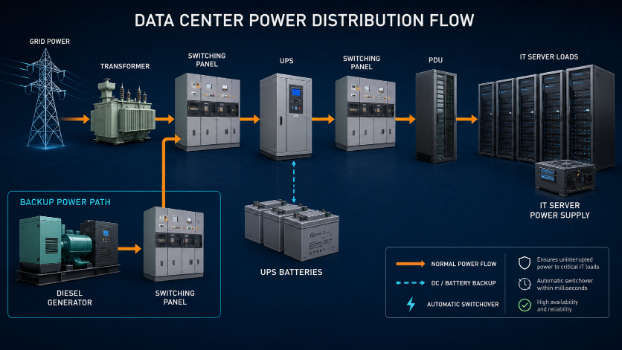
Common Clash Types in Data Center Projects
Common conflicts include electrical conduits crossing ductwork, cable trays blocking access to mechanical equipment, cooling systems interfering with power distribution, and fiber infrastructure competing with MEP pathways.
These are not minor drawing issues. They affect installation sequence, access clearance, and maintainability.
From Clash Detection to Resolution
A Common Data Environment, or CDE, helps keep issues, models, documents, and decisions in one shared platform. This reduces the risk of teams working from outdated information.
Manual tracking often fails when hundreds of issues move across multiple subcontractors.
Power Infrastructure Coordination
Power infrastructure is one of the highest-risk coordination areas in a data center. Electrical distribution, switchgear, busway, power distribution networks, conduits, and cable tray routing all require precise planning.
These systems also need access clearance for commissioning, maintenance, replacement, and safety.
Electrical Distribution and Power Routing
Electrical distribution paths must be coordinated early because they influence room layouts, ceiling zones, equipment pads, and trade sequencing. A late change to busway or conduit routing can disrupt mechanical and cooling infrastructure.
BIM coordination helps teams see these conflicts before they create rework.
Backup Power Infrastructure
Backup generators, UPS systems, battery storage systems, and redundant power supplies are not isolated equipment packages. They require ventilation, fuel or battery planning, access zones, controls integration, and commissioning support.
Poor coordination here can threaten both schedule and reliability.
Redundancy Models and Reliability Planning
N+1, N+2, and 2N redundancy configurations increase physical complexity. More equipment, more pathways, and more separation rules mean more coordination risk.
The GC must ensure redundancy requirements are constructible, maintainable, and aligned with uptime goals.
Cooling, Airflow, and Thermal Coordination
Cooling is deeply connected to power. Rack densities and power density directly shape heat load, airflow patterns, and cooling system design.
If airflow distribution is compromised by poor routing or blocked access, energy consumption rises and thermal risk increases.
Cooling Systems and HVAC Layouts
HVAC systems, CRAH/CRAC units, ductwork, chilled water piping, and liquid cooling distribution must be coordinated with electrical infrastructure. Cooling equipment also needs service access and clear airflow paths.
A system can be correctly designed but poorly coordinated.
Airflow, Rack Density, and Power Density
Hot aisle/cold aisle planning depends on controlled airflow. Higher rack densities increase thermal load, which makes coordination between power and cooling infrastructure even more important.
Small layout decisions can affect long-term energy efficiency and operational performance.
Network, Fiber, and Low-Voltage Coordination
Network planning and fiber infrastructure add another layer of congestion. Cable management networks must remain accessible, separated, and scalable.
BICSI guidelines can support better planning, but field execution still depends on accurate coordination.
Cable Management and Service Access
Cable tray routing should protect capacity, access, and future expansion. Poor cable coordination creates long-term facility management issues, especially when upgrades or troubleshooting are required.
Prefabrication and Modular Construction
Prefabrication and modular construction can reduce field labor and improve quality, but only when the coordination data is accurate.
Modular MEP, electrical skids, and mechanical racks depend on reliable model dimensions and connection points.
Why Modular MEP Needs Reliable Coordination Data
When prefabrication workflows are based on weak coordination, errors are manufactured before they ever reach the site. Accurate BIM coordination reduces delays, rework, and field adjustment.
Shared Platforms, CDEs, and Project Information Management
A shared platform improves project information management by connecting models, documents, issue workflows, and decisions. This is where manual coordination becomes visibly limited.
Why a Common Data Environment Matters
A CDE gives teams one place to manage revisions, comments, approvals, and issue status. It reduces confusion over which model or document is current.
Open Data, IFC, and ISO 19650
IFC supports data exchange across tools, while ISO 19650 provides structure for information management. Together, they help turn coordination into a controlled process.
Commissioning, Handover, and Facility Management
Coordination does not end at installation. Commissioning, asset management, facility management, and lifecycle management all depend on accurate project data.
From Construction Model to Operational Asset
A clean model helps operations teams understand equipment locations, access paths, and system relationships. This improves maintenance accessibility after handover.
Digital Twins and Real-Time Visibility
Digital twins extend BIM into operations through monitoring, predictive analytics, and energy modeling. They support better decisions across the facility lifecycle.
Energy Efficiency, Sustainability, and Performance Metrics
Better coordination also supports sustainability. Efficient layouts reduce waste, rework, energy consumption, and operational inefficiency.
Power Usage Effectiveness and Energy Modeling
Power Usage Effectiveness, or PUE, is affected by cooling system design, airflow, rack density, and power infrastructure. BIM-based energy modeling helps teams evaluate these relationships earlier.
Sustainability in Data Center Construction
Carbon footprint analysis, renewable energy integration, LEED Gold targets, and ASHRAE standards all benefit from coordinated design and accurate system planning.
Why GCs Need to Move Beyond Manual Coordination
GCs do not need more spreadsheets. They need connected coordination systems that make conflicts, ownership, revisions, and decisions visible.
The Cost of Staying Manual
Manual coordination appears cheap until RFIs, change orders, delays, rework, and field issues accumulate. In data center construction, those costs compound quickly.
What Modern Coordination Should Deliver
Modern coordination should deliver shared models, clash detection, issue tracking, document control, model integration, and clear trade accountability.
Future Trends in Data Center Coordination
The future of data center delivery will be more modular, more data-driven, and more connected across design, construction, commissioning, and operations.
AI-Assisted Coordination and Predictive Risk
Predictive analytics will help teams prioritize issues, detect schedule risk, and identify coordination errors before they become field problems.
More Modular, More Data-Driven Delivery
As modular construction and prefabrication workflows grow, reliable BIM data will become even more important for speed, quality, and repeatability.
Conclusion: Manual Coordination Cannot Carry Mission-Critical Complexity Forever
Manual coordination still exists because it is familiar, but familiarity is not enough for mission-critical facilities. Data center construction needs BIM coordination, clash detection, CDE workflows, and disciplined project information management. For GCs, the goal is not just fewer clashes. It is better uptime protection, cleaner commissioning, stronger cost control, and a facility that can operate reliably long after construction ends.