
Why Electrical Systems Dominate Data Center BIM Complexity
Data centers are engineered around a single uncompromising objective, continuous uptime. Every system contributes to that goal, but electrical infrastructure carries the greatest burden. It is not only responsible for delivering power, it defines redundancy, governs reliability, shapes spatial layout, and directly influences cooling performance and operational efficiency. When translated into BIM environments, this responsibility becomes complexity. Electrical systems span every zone of the facility, intersect with mechanical systems, and require precision at a level that exposes even minor coordination gaps. That is why, in practice, electrical systems dominate data center BIM complexity.
Understanding the Core Role of Electrical Systems in Data Centers
Electrical systems sit at the center of data center design because every workload ultimately depends on stable power. Unlike typical commercial buildings, failure here is not an inconvenience, it is an outage. BIM models must therefore capture not just geometry, but the logic of power flow, redundancy, and system behavior under stress.
Why Power Infrastructure Drives Everything
Power infrastructure determines uptime, reliability, and operational resilience. From incoming utility feed through transformers and switchgear to final distribution, each layer must be modeled with clarity. Even small inaccuracies in power distribution representation can cascade into major design conflicts, particularly when load paths and redundancy are misaligned.
The Link Between Electrical and Cooling Systems
Electrical load directly drives cooling demand. As rack kW increases, so does heat rejection. HVAC systems, including CRAC and CRAH units, must align with electrical density. This interdependence makes airflow distribution, hot aisle/cold aisle containment, and cooling systems inseparable from electrical design within BIM environments.
Electrical Distribution Architecture in BIM Models
The electrical distribution network in a data center is not linear. It is layered, redundant, and spatially dense. BIM must represent this complexity accurately to avoid downstream coordination failures.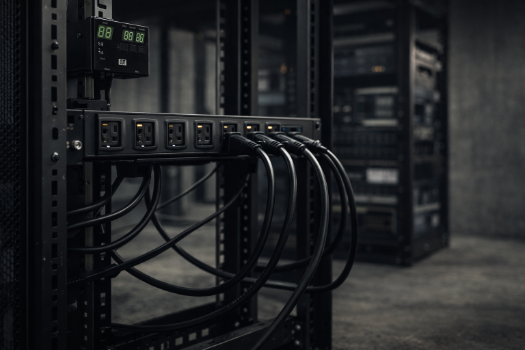
From Utility Feed to Rack-Level Power Distribution
Power flows through multiple stages, utility feed, transformers, switchgear, UPS systems, and PDUs before reaching rack-level power distribution. Electrical skids and modular systems further complicate layouts by introducing prefabricated elements that must integrate seamlessly into the overall model.
Routing Complexity: Cable, Conduit, and Busway Systems
Cable tray networks, banks of conduit, and busway systems occupy significant physical space. Routing these elements without clashes is a constant challenge. In high-density zones, electrical pathways compete directly with HVAC ductwork and structural constraints, requiring detailed coordination.
Load Calculations and Capacity Planning
Load calculations and capacity planning are not static exercises. They evolve as equipment densities change. BIM models must account for current loads while allowing future scalability, which adds another layer of abstraction and complexity to electrical modeling.
Redundancy Models and Reliability Engineering
Redundancy is what separates data centers from conventional facilities. It is also one of the primary drivers of BIM complexity.
Understanding N+1, 2N, and 2N+1 Configurations
Redundancy models such as N+1, 2N, and 2N+1 require parallel electrical systems that operate independently yet simultaneously. BIM must represent these duplicated paths clearly, ensuring that no single point of failure exists.
Tier III and Tier IV Design Requirements
Tier III and Tier IV facilities impose strict uptime requirements. These standards dictate how electrical infrastructure is designed, from distribution pathways to maintenance isolation. BIM coordination becomes critical in verifying compliance with these requirements.
Backup Power Systems: UPS and Generators
UPS systems and generators form the backbone of backup power. The transition between normal power and backup power must be seamless. Modeling this interaction, including switchgear sequencing and generator integration, introduces significant technical depth.
Coordination Challenges in BIM Environments
Electrical systems are often the source of the most complex coordination issues in BIM due to their scale and routing density.
Clash Detection Across MEP Systems
Clash detection is especially critical where cable trays intersect with HVAC ducts, piping, and structural elements. Resolving these conflicts early reduces costly rework and ensures constructability.
Interaction with HVAC and Cooling Infrastructure
Electrical infrastructure must align with HVAC systems to maintain effective cooling. Airflow distribution, CRAC and CRAH placement, and containment strategies all depend on how electrical loads are distributed across the facility.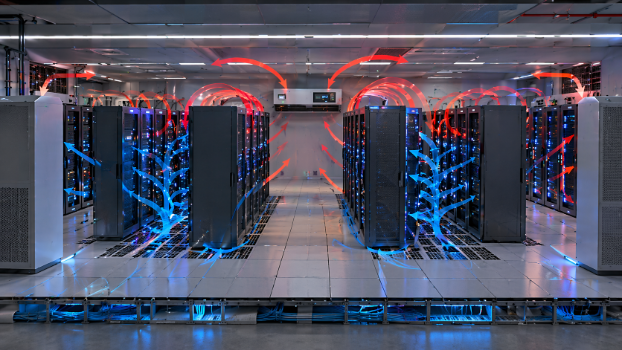
Raised Floors and Spatial Constraints
Raised floors are used for both cable management and airflow. This creates tight spatial constraints where electrical and cooling systems must coexist. BIM models must balance these competing demands without compromising accessibility or performance.
Power Quality, Monitoring, and Operational Intelligence
Delivering power is only part of the challenge. Maintaining its quality and monitoring system performance in real time is equally critical.
Power Quality and Harmonic Distortion
Poor power quality and harmonic distortion can damage sensitive equipment. Electrical systems must be designed to mitigate these risks, and BIM models often incorporate these considerations during planning.
Real-Time Monitoring and Digital Twin Integration
Real-time monitoring systems provide visibility into electrical performance. When integrated with a digital twin, they enable predictive maintenance and operational optimization, bridging the gap between design and operation.
Capacity Planning and System Visibility
Continuous monitoring supports capacity planning by identifying underutilized or overloaded systems. This data-driven approach enhances reliability and long-term efficiency.
Energy Efficiency and Sustainability Considerations
Energy consumption is a defining challenge in modern data centers, and electrical systems play a central role in addressing it.
Power Usage Effectiveness (PUE) and Metrics
PUE remains the primary metric for evaluating efficiency. Electrical losses in power distribution, conversion, and transmission directly impact overall performance.
Energy Analysis and CFD Modeling
Energy analysis, often combined with CFD modeling, helps optimize both electrical and cooling performance. These tools simulate airflow distribution and thermal behavior, improving system design.
Reducing Losses: Power Conversion and Transmission
Transmission losses and inefficient power conversion can lead to stranded energy. Addressing these inefficiencies improves both sustainability and operational cost.
Advanced Cooling-Electrical Integration
As rack densities increase, the relationship between electrical systems and cooling becomes more tightly coupled.
Liquid Cooling and High-Density Environments
Liquid cooling is becoming more common in high-density environments. It introduces new coordination challenges, particularly around electrical safety and integration within BIM models.
Airflow Distribution and Rack-Level Cooling
Effective airflow distribution remains essential. Aligning cooling strategies with rack-level power distribution ensures stable performance and avoids localized overheating.
Future Trends Shaping Electrical BIM Complexity
Data center design is evolving rapidly, and electrical systems are at the forefront of this transformation.
Modular and Scalable Electrical Systems
Modular designs and electrical skids enable faster deployment. However, they also require BIM models to handle prefabricated components with precision and flexibility.
AI-Driven Monitoring and Smart Infrastructure
Advancements in monitoring and automation are enabling smarter infrastructure. Real-time monitoring combined with analytics improves decision-making and reduces downtime risks.
Sustainability and Next-Gen Energy Strategies
Future data centers will increasingly rely on renewable energy and advanced efficiency strategies. Electrical systems will play a key role in achieving sustainability targets.
Conclusion: Why Electrical Systems Dominate BIM Complexity
Electrical systems dominate data center BIM complexity because they sit at the intersection of power, redundancy, cooling, and operational intelligence. They require precise modeling of distribution networks, integration with backup power systems, alignment with HVAC infrastructure, and continuous monitoring for performance and efficiency. As data centers become more advanced, the role of electrical systems will only expand, making BIM an essential tool for managing this growing complexity.