
Why Data Center Construction Requires BIM Coordination by Contract
Data center construction operates under a fundamentally different set of expectations than traditional buildings. These are mission-critical facilities where uptime, system reliability, and operational continuity are not just goals but contractual obligations. Every cable tray, conduit, and cooling pathway must align with complex electrical distribution and thermal requirements. In this environment, BIM coordination becomes the backbone of project execution. When it is formally defined by contract, it transforms from a design tool into a controlled delivery system that ensures every stakeholder works from the same coordinated reality.
Understanding BIM Coordination in Data Center Construction
What BIM Coordination Means in Mission-Critical Facilities
BIM coordination in data center BIM environments goes far beyond visualization. It is the process of integrating architectural, structural, and MEP coordination into a unified workflow that reflects real-world constructability. In mission-critical facilities, where even minor misalignments can impact uptime, BIM coordination ensures that every system is modeled with precision and intent.
Why Data Centers Require a Federated Model Approach
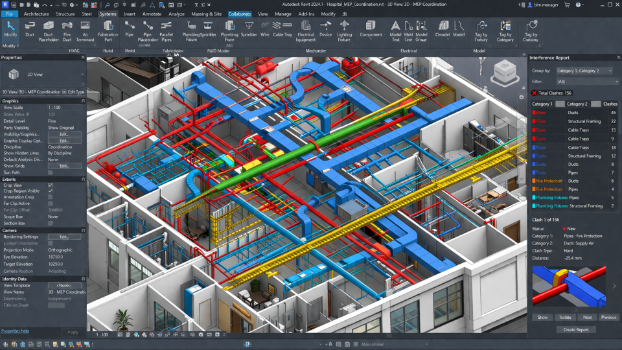
A federated model allows multiple disciplines to contribute to a single coordinated environment without losing ownership of their systems. Electrical, mechanical, and structural teams continuously align their models, enabling real-time conflict resolution. This is especially critical in data centers where power infrastructure and cooling systems must coexist in extremely tight spaces.
Role of BIM Execution Plan in Contractual Coordination
The BIM execution plan defines how coordination is performed, who is responsible, and how models are shared and updated. When embedded in contracts, it ensures accountability across all parties. Without it, coordination becomes inconsistent, increasing the risk of delays, clashes, and misaligned deliverables.
Core Systems That Demand BIM Coordination
Power Infrastructure and Electrical Distribution Complexity
Data centers rely on highly structured power distribution systems that include switchgear, feeders, busways, and bus ducts. Electrical rooms must be precisely coordinated to avoid voltage drops and maintain efficient electrical distribution. BIM coordination ensures that these systems are routed accurately within spatial constraints.
Redundant Power Systems and Uptime Requirements
Redundancy is central to uptime. Dual utility feeds, UPS systems, battery storage, backup generators, and automatic transfer switches must be integrated seamlessly. BIM coordination helps visualize and validate redundant power systems, ensuring no single point of failure exists in the design.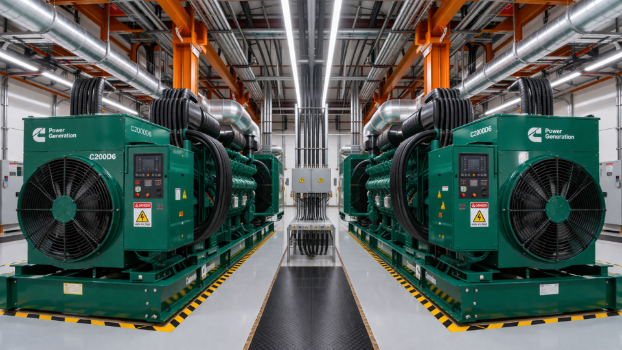
Cooling Systems and Thermal Management Challenges
Cooling systems such as CRAC, CRAH, chilled water systems, and liquid cooling must be carefully aligned with server layouts. Thermal management is directly tied to cooling load distribution, and improper coordination can lead to hotspots that compromise performance.
Airflow, Density, and Spatial Coordination
Airflow Optimization and Containment Strategies
Controlled airflow is achieved through hot aisle and cold aisle containment strategies. BIM coordination enables accurate placement of containment systems, ensuring efficient airflow optimization and minimizing energy loss.
Rack Density and Thermal Hotspot Management
As rack densities increase, thermal hotspots become more likely. Computational fluid dynamics (CFD) simulations allow engineers to predict airflow behavior and adjust designs before construction. This level of analysis is only possible with well-coordinated BIM models.
MEP Routing and Space Constraints
Cable trays, conduits, and piping networks compete for limited space. Raised floor and underfloor systems add another layer of complexity. BIM coordination ensures that routing is efficient, maintainable, and free of conflicts.
Clash Detection and Constructability
Importance of Clash Detection in Dense Environments
Clash detection using tools like Navisworks identifies conflicts between systems before they reach the field. In data centers, where density is high, resolving clashes early prevents costly rework and delays.
Constructability and Installation Sequencing
Installation sequencing ensures that systems are built in the correct order. BIM coordination allows teams to plan construction workflows, reducing inefficiencies and improving constructability.
Maintaining Clearances and Service Access
Equipment clearances and maintenance zones must be preserved to allow ongoing facility management. BIM models ensure that service access is not compromised by design decisions.
Prefabrication and Accelerated Project Delivery
Role of Prefabrication and Modular Construction
Prefabrication and off-site fabrication enable faster deployment of modular power and MEP systems. BIM coordination ensures that prefabricated components fit precisely within the project.
Fabrication-Ready Models and LOD Requirements
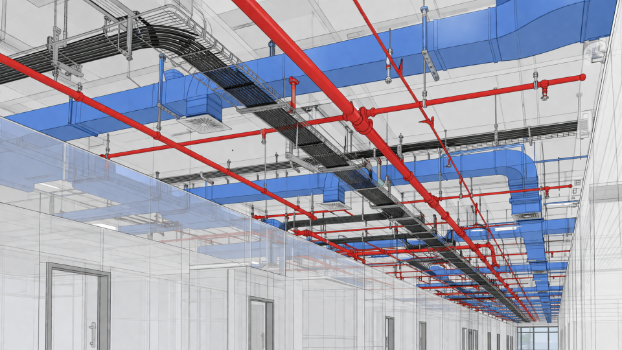
LOD 400 models provide the detail required for fabrication-ready models, while LOD 500 supports as-built documentation. This level of detail is essential for accuracy and lifecycle use.
Quantity Take-Offs and Cost Accuracy
Quantity take-offs and BOQs derived from BIM models improve cost accuracy. This reduces financial risk and enhances project predictability.
Digital Delivery, Tools, and Collaboration
Key BIM Tools and Platforms
Tools like Revit and Navisworks enable modeling, coordination, and clash detection. They form the core of digital delivery workflows in data center projects.
Cloud-Based Field Coordination and Real-Time Updates
Cloud-based field coordination platforms allow teams to access updated models in real time. This improves communication and reduces errors during construction.
Digital Twin and Lifecycle Integration
Digital twin models extend BIM into operations, supporting facility management, monitoring, and predictive maintenance throughout the lifecycle.
Compliance, Standards, and Risk Mitigation
Industry Standards and Code Compliance
Compliance with NEC, ASHRAE, Uptime Institute Tiers, and BICSI standards is critical. BIM coordination ensures these requirements are integrated into the design from the start.
Commissioning and System Validation
Commissioning validates that all systems perform as intended. BIM models provide a reference for verifying installation and performance.
Security Monitoring and Operational Readiness
Security monitoring systems must be integrated with operational workflows. BIM coordination ensures readiness for live environments.
Sustainability and Energy Performance
Energy Efficiency and Performance Metrics
Energy efficiency is measured through metrics like PUE. BIM coordination supports optimized energy consumption and performance analysis.
Renewable Energy and Environmental Impact
Integration of renewable energy reduces environmental impact. Coordinated BIM models help align these systems with core infrastructure.
Green Certifications and Sustainable Operations
LEED certification and sustainability targets are easier to achieve with accurate BIM data. This supports long-term sustainable operations.
Why BIM Coordination Must Be Defined by Contract
Accountability and Role Definition
Contracts define roles, responsibilities, and deliverables for BIM coordination. This ensures that all parties are aligned and accountable.
Reducing Risk in Mission-Critical Projects
Formalizing BIM coordination reduces risk by preventing miscommunication, delays, and costly errors. It ensures systems are designed and installed correctly.
Ensuring Consistency Across Stakeholders
Standardized BIM workflows ensure consistency across contractors, engineers, and operators, improving overall project outcomes.
Future Trends in Data Center BIM Coordination
AI-Driven Coordination and Predictive Modeling
AI-driven tools are enhancing BIM coordination by predicting clashes and optimizing system layouts before construction begins.
Advanced Simulation and Real-Time Monitoring
Real-time monitoring and advanced simulations provide deeper insights into system performance, improving decision-making.
Integration of BIM with Smart Data Center Operations
BIM is increasingly integrated with IoT and smart systems, enabling intelligent facility management and operational efficiency.
Conclusion
The Strategic Importance of BIM Coordination in Data Centers
BIM coordination is not just a design tool but a strategic requirement for delivering reliable, efficient, and scalable data centers. When defined by contract, it ensures accountability, reduces risk, and enables successful execution in mission-critical environments.