
Why Data Center BIM Needs a Different Mindset
Data center BIM demands a fundamentally different mindset because the consequences of design decisions extend far beyond construction into real-time operational risk. In most buildings, inefficiencies translate into cost overruns or coordination issues. In a data center, they translate into downtime, compromised uptime guarantees, and millions in lost revenue. That shift forces BIM to evolve from a coordination tool into a performance-driven system where electrical architecture, cooling systems, airflow, and redundancy are modeled with precision. Every conduit, cable tray, and chilled water line must serve a purpose tied to reliability, efficiency, and operational continuity.
Understanding the Mindset Shift in Data Center BIM
From Geometry to Mission-Critical Infrastructure
Traditional BIM prioritizes geometry, clash detection, and visual coordination. In data centers, BIM represents mission-critical infrastructure. The focus shifts to uptime, operational reliability, and fault-tolerant infrastructure. Models are not just spatial references but representations of how systems behave under load, failure conditions, and maintenance cycles. Designing for concurrent maintainability means every system must remain operational even during maintenance, pushing BIM into the realm of engineering logic rather than visual accuracy.
Why Traditional BIM Workflows Fall Short
Standard workflows fail to account for electrical load distribution, cooling efficiency, and redundancy strategies. A typical model may show where systems fit, but it does not inherently validate power distribution paths or airflow patterns. Without integrating energy consumption, thermal management, and system interdependencies, BIM becomes incomplete. Data center projects demand that modeling incorporates performance metrics alongside geometry from day one.
Core Systems That Define Data Center BIM
Electrical Backbone and Power Distribution
The electrical backbone defines the entire facility. Power flows from utility service entry through switchgear, UPS systems, and bus duct or busway networks before reaching panels and racks. Dual power feeds ensure redundancy, while backup generators and generator yard layouts provide resilience during outages. Electrical modules and skids are increasingly prefabricated, requiring precise BIM coordination. Load forecasting and electrical load distribution must be modeled early to prevent capacity bottlenecks and ensure scalability.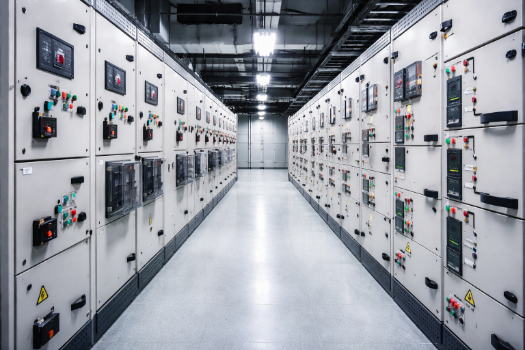
Redundancy Models and Reliability Engineering
Redundancy is not optional. It is engineered into every layer of the system. UPS systems, backup generators, and distributed pathways eliminate single points of failure. Designing for uptime requires clear separation of redundant systems, ensuring operational continuity even during faults. This approach supports Tier-level expectations and reinforces reliability as a measurable outcome, not a theoretical goal.
Cooling Systems and Thermal Management
Cooling systems are as critical as power systems. CRAH systems, CRAC units, chillers, and cooling towers must be coordinated with electrical loads and spatial constraints. Chilled water systems require careful thermal planning to handle high-density environments. Cooling efficiency directly impacts energy consumption, making it a core design parameter. Preventing hotspots and maintaining consistent temperatures demands a tightly integrated approach between mechanical and electrical modeling.
Airflow, Containment, and Cooling Interaction
Airflow Patterns and Hot/Cold Aisle Design
Airflow is engineered, not assumed. Hot-aisle and cold-aisle configurations define how air moves through the facility. Airflow patterns must be modeled to ensure that heat is effectively removed from equipment. Raised floors and underfloor systems often support air distribution, requiring coordination between structural, mechanical, and electrical systems.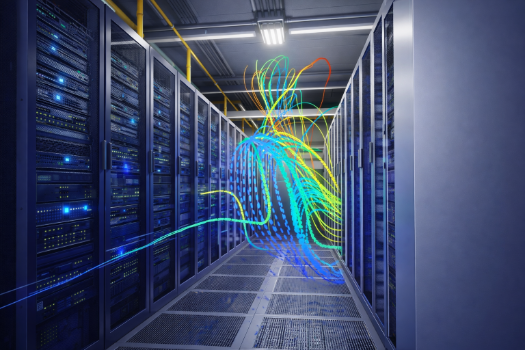
Containment Strategies for Efficiency
Containment strategies isolate hot and cold air streams to improve cooling efficiency. Without proper containment, mixing air reduces system performance and increases energy consumption. HVAC systems must maintain balance while supporting these strategies, ensuring consistent temperature control across the facility.
Simulation and Performance Validation
Simulation bridges design and reality. Using airflow simulation and thermal analysis, teams can validate performance before construction. These simulations predict how systems behave under different loads, enabling adjustments that improve efficiency and reduce risk. This level of validation is essential for mission-critical infrastructure.
BIM for Constructability and Delivery Efficiency
Clash Detection and Coordination at Scale
Clash detection in data centers goes beyond avoiding collisions. It ensures that cable trays, conduits, busways, and cooling systems can be installed without compromising performance or maintenance access. High-density environments amplify coordination challenges, making precision essential. Accurate models reduce RFIs and streamline communication across teams.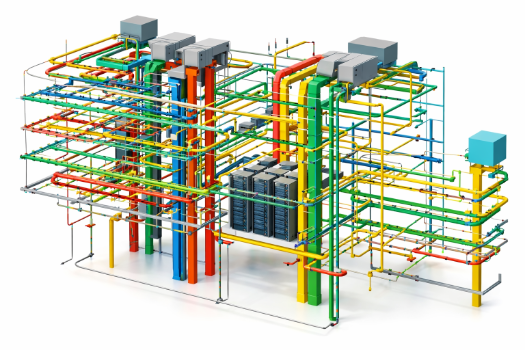
Prefabrication and Modular Construction
Prefabrication is a key driver of speed and quality. Fabrication-ready models allow electrical skids, modules, and assemblies to be built offsite and installed efficiently. This reduces onsite complexity and improves consistency. Modular approaches require BIM models to be highly detailed and aligned with manufacturing processes.
4D BIM and Project Sequencing
4D BIM introduces time into the equation. Sequencing and phasing become critical when coordinating multiple systems in parallel. Proper scheduling ensures that installations occur in the correct order, minimizing delays and supporting efficient commissioning. This approach reduces rework and accelerates project delivery.
Commissioning, Maintenance, and Lifecycle Integration
Commissioning for Zero-Failure Environments
Commissioning validates that systems perform as designed. In data centers, this process is rigorous because failure is not an option. BIM supports commissioning by providing accurate system representations and identifying potential issues early. This reduces downtime risk during startup.
Maintenance Planning and Access
Maintenance must be planned from the design stage. Systems require access for regular maintenance cycles without disrupting operations. BIM helps visualize access zones, ensuring that equipment can be serviced safely. Predictive maintenance strategies rely on accurate models and data integration.
Digital Twin and Facility Management
The transition from BIM to digital twin enables real-time monitoring and facility management. Digital twins integrate data from operational systems, providing insights into performance and asset management. This supports predictive maintenance and enhances long-term reliability.
Energy Efficiency, Sustainability, and Compliance
Measuring Performance with PUE
Power Usage Effectiveness (PUE) is a critical metric for evaluating efficiency. It measures how effectively energy is used within the facility. BIM helps optimize designs to reduce energy consumption and improve PUE, directly impacting operational costs.
Sustainable Data Center Design
Sustainability is increasingly important. Integrating renewable energy sources, optimizing water usage in cooling systems, and reducing environmental impact are key goals. LEED certification and sustainability benchmarks influence design decisions, pushing teams to innovate.
Compliance and Industry Standards
Compliance ensures safety and reliability. Data centers must meet strict electrical and HVAC standards. BIM supports compliance by providing accurate documentation and ensuring systems align with regulatory requirements.
Future Trends and Advanced Innovations
AI, Predictive Maintenance, and Smart Systems
AI-driven systems are transforming operations. Predictive maintenance uses data to anticipate failures before they occur. Smart systems optimize power distribution and cooling efficiency in real time, improving operational reliability.
Next-Generation Cooling and Energy Systems
Cooling technologies continue to evolve. Advanced chilled water systems, improved airflow management, and energy-efficient designs are shaping the future. These innovations reduce energy consumption while supporting higher densities.
The Rise of Fully Integrated Digital Ecosystems
BIM is becoming the foundation for fully integrated digital ecosystems. Digital twins, monitoring systems, and simulation tools work together to create intelligent environments. This integration enhances decision-making and supports long-term performance.
Conclusion: Why Data Center BIM Demands a Different Approach
Data center BIM is not simply a modeling exercise. It is a strategic tool for designing, building, and operating mission-critical infrastructure. By integrating power distribution, cooling systems, redundancy, and lifecycle considerations, BIM enables teams to achieve uptime, efficiency, and scalability. This mindset shift is essential for meeting the demands of modern data centers, where performance and reliability define success.