
Why BIM Review Processes Need to Change
Modern BIM review cannot remain a visual coordination exercise. In data center and mission-critical facilities, the model is no longer just a place to find clashes. It is where uptime risk, redundant power paths, cooling performance, constructability, facility handover, and long-term operations must be tested before field work begins. A cable tray that fits geometrically may still block maintenance access. A UPS route may pass clash detection but compromise A/B power path separation. A chilled water line may coordinate on screen while disrupting airflow pathways. That is why BIM review processes need to change from simple model checking into a disciplined reliability workflow.
Why Traditional BIM Review Processes Are No Longer Enough
Traditional BIM design review often focuses on visible conflicts, coordination meetings, and model updates. That works for simpler buildings, but data center BIM coordination demands deeper validation. The review process must protect uptime, reduce downtime risk, and support operational resilience.
The Shift From Visual Review to System-Level Validation
The question is no longer only, “Does this fit?” A modern BIM review process must ask, “Does this system remain redundant, accessible, maintainable, and reliable under real operating conditions?”
Why Data Centers Expose the Weaknesses of Standard BIM Review
Data centers combine dense MEP systems, high power density, UPS systems, backup generators, switchgear rooms, cooling infrastructure, and underfloor services. Standard clash detection cannot fully evaluate those dependencies.
Core Concepts Behind a Modern BIM Review Process
A stronger BIM coordination process begins with a federated model, clear standards, version control, and traceable issue management. Without those foundations, the model becomes a collection of geometry rather than a reliable construction tool.
Federated Models and Model Aggregation
Model aggregation brings architectural, structural, electrical, HVAC, fire protection, telecom, and vendor models into one review environment. For mission-critical facilities, this federated model must show how systems interact, not just where they sit.
Common Data Environment and Version Control
A common data environment, or CDE, keeps teams aligned around the latest model version. Version control, audit trails, documentation, and traceability prevent outdated information from driving expensive field decisions.
BIM Execution Plan as the Review Rulebook
The BIM Execution Plan defines LOD, naming rules, issue workflows, vendor content rules, and final verification procedures. A strong BEP turns BIM coordination from a weekly discussion into a controlled technical process.
From Clash Detection to Issue Management
Clash detection identifies problems. Issue management closes them. That distinction matters because unresolved issues often reappear as field rework, delayed installation, or compromised access.
Why Clash Detection Alone Is Not Enough
A conduit crossing a chilled water pipe is easy to flag. Harder problems include cable trays blocking maintenance clearance, bus duct routing reducing access, or redundant power systems sharing the same risk zone.
Building a Closed-Loop Issue Management Workflow
Effective issue resolution follows a clear cycle: detect, classify, assign, resolve, update, verify, and document. Every major model review decision should leave a traceable record.
Using BCF-Based Issue Tracking
BCF workflows, BIMcollab, BCF Manager, Navisworks, Solibri, and Revit help preserve viewpoints, comments, assignments, and status. This creates accountability across distributed project teams.
Electrical BIM Review for Mission-Critical Power Infrastructure
Electrical BIM review is one of the most important parts of data center coordination. Power distribution, switchgear, feeders, circuits, panels, PDUs, bus ducts, conduits, and cable trays all need spatial and operational review.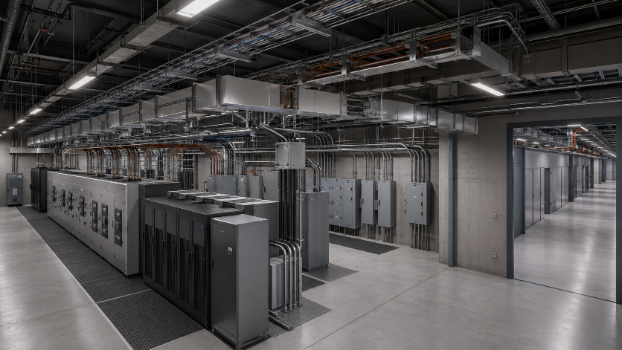
Reviewing Power Distribution Pathways
Power distribution routes must be reviewed for clearance, separation, constructability, feeder lengths, future capacity, and maintenance access. A clean electrical layout on paper can still fail in the field.
UPS, Generators, ATS, and Backup Power Systems
UPS routing, backup generators, automatic transfer switches, and ATS rooms must be coordinated as one backup power system. Ventilation, access, fuel paths, cable routing, and emergency operation all matter.
Load Balancing, Breaker Schedules, and Power Capacity
BIM review should support more than geometry. Breaker schedules, load balancing, live load balance, power capacity, and power density become more useful when connected to accurate model data.
Redundancy Validation and Uptime Protection
Redundancy is not guaranteed just because duplicate systems exist. Redundancy validation checks whether redundant power paths actually remain independent under failure or maintenance conditions.
Validating A/B Power Path Separation
A-side and B-side routes must avoid shared fault domains. If A/B power paths run through the same congested ceiling zone or service corridor, the facility may have hidden uptime risk.
Reviewing Fault Domains and Failure Scenarios
A proper BIM review tests failure scenarios. What happens if one UPS room is offline? What if one utility feed fails? What if maintenance blocks a critical access path?
Why Redundancy Review Needs More Than Standard Clash Rules
Standard clash rules catch geometry conflicts, not dependency conflicts. Redundant power systems require system segregation, model segmentation, and review logic tied to operational resilience.
Cooling, Airflow, and Electrical Coordination Must Be Reviewed Together
Power and cooling are inseparable in data centers. Cooling systems, HVAC routing, chilled water piping, airflow pathways, and electrical infrastructure must be reviewed as interacting systems.
Coordinating Cooling Infrastructure With Electrical Systems
Cable trays, bus ducts, switchgear rooms, and chilled water systems often compete for the same space. A coordinated layout must protect both electrical access and cooling performance.
Airflow Management and Thermal Planning
Hot aisle containment, cold aisle containment, airflow management, heat pockets, and thermal planning directly affect uptime and energy efficiency.
Underfloor and Raised Floor Coordination
Raised floor coordination is especially sensitive. Underfloor services, conduits, chilled water piping, and cable trays must preserve airflow pathways and future maintenance clearance.
Constructability, Sequencing, and Phased Deployment
A model can be coordinated but still difficult to build. Constructability review checks whether installation can happen safely, logically, and in the right order.
Reviewing Models for Buildability
Access validation, working clearance, trade stacking, and installation sequence should be reviewed before the project reaches the field.
Sequencing Overlays for Phased Construction
Phased deployment and phased installation are common in critical infrastructure. Sequencing overlays help teams understand what is installed, what remains live, and what must stay accessible.
Prefabrication and Fabrication-Ready BIM
Prefabrication, modular construction, shop drawings, cable tray runs, and fabrication-ready models require accurate LOD and disciplined coordination.
Vendor Models, Model Segmentation, and Data Quality
Vendor model integration can introduce inaccurate geometry, missing clearance zones, or excessive detail. Poor model data slows BIM review and weakens handover value.
Vendor Model Integration Problems
UPS systems, switchgear, PDUs, generators, and cooling equipment need accurate connection points, clearance envelopes, and equipment data.
Model Segmentation for Large Data Center BIM Models
Model segmentation by system, zone, level, and phase keeps large data center BIM models usable and reviewable.
Data Quality and LOD Standards
LOD standards determine whether the model is useful for coordination, shop drawings, as-built models, digital twins, and facility management.
Code Compliance, Standards, and Technical Review Rules
Modern BIM review should support code compliance, especially around electrical systems, maintenance clearance, and equipment access.
NEC Compliance in Electrical BIM Review
NEC compliance affects switchgear, panels, conduits, feeders, and access zones. BIM can support review, but engineering judgment remains essential.
Access, Clearance, and Maintenance Validation
Maintenance access conflicts often do not appear as hard clashes. That makes access validation critical for UPS units, switchgear, generators, panels, and chilled water systems.
Documentation and Audit Trails
Documentation, audit trails, traceability, and final verification reduce ambiguity when decisions are challenged later.
BIM Tools and Platforms That Support Modern Review
Tools support the process, but they do not replace it. Revit, Navisworks Manage, Solibri Model Checker, BIMcollab Zoom, Autodesk Construction Cloud, Autodesk BIM Collaborate, ACC Coordinate, IFC, BCF, COBie, and DCIM each play a role.
Revit, Navisworks, and Clash Review
Revit supports authoring, while Navisworks supports clash detection and coordination review.
Solibri, BIMcollab, and Issue-Based Coordination
Solibri improves rule-based checking, while BIMcollab and BCF workflows improve issue ownership and closure.
Autodesk Construction Cloud and CDE-Based Review
Cloud-based CDE workflows improve collaboration, version control, and model review transparency.
IFC, COBie, and Data Exchange for Handover
IFC and COBie help transfer model and asset data into facility handover and operations.
BIM Review for Facility Management and Operations
The best BIM review process prepares the model for long-term facility management, not just construction completion.
From Construction Model to As-Built Model
Accurate model updates, equipment data, and final verification turn a coordinated model into a useful as-built model.
Digital Twin and Operational Data
A digital twin depends on reliable geometry, system relationships, operational data, and maintenance history.
DCIM and Predictive Maintenance
DCIM, monitoring dashboards, real-time monitoring, live load balance, and predictive maintenance connect BIM to actual facility performance.
Energy Efficiency, Sustainability, and Performance Metrics
BIM review is increasingly tied to energy efficiency, energy consumption, sustainability, ESG reporting, and Power Usage Effectiveness.
Power Usage Effectiveness and Energy Visibility
PUE improves when power distribution and cooling infrastructure are reviewed together, not in isolation.
Load Balancing and Capacity Planning
Capacity planning becomes stronger when BIM data supports power capacity, power density, and future expansion decisions.
Sustainability and ESG Reporting
Accurate BIM data supports energy tracking, lifecycle planning, and more credible ESG reporting.
What a Better BIM Review Process Should Look Like
A better process is structured, traceable, system-aware, and operations-focused.
Step 1: Define Review Standards Before Modeling Begins
Set BEP, LOD, CDE, naming rules, vendor content rules, and system segregation early.
Step 2: Aggregate and Segment Models Properly
Use federated models, model aggregation, and model segmentation to keep review manageable.
Step 3: Run Clash Detection With System Context
Filter clashes by severity, redundancy risk, access impact, and sequencing impact.
Step 4: Manage Issues to Closure
Assign owners, update models, verify resolutions, and preserve the audit trail.
Step 5: Validate Handover and Operations Readiness
Confirm COBie data, as-built model quality, digital twin readiness, and DCIM alignment.
Future Trends Changing BIM Review
BIM review is moving toward live, data-driven infrastructure intelligence.
Real-Time Monitoring and Live Infrastructure Data
Monitoring dashboards and operational data will increasingly inform model validation.
Digital Twins as the Next Stage of BIM Review
Digital twins extend BIM review beyond construction into performance, maintenance, and resilience.
Sustainability-Driven BIM Review
Energy efficiency, PUE, load balancing, cooling performance, and ESG reporting will become stronger review criteria.
Conclusion: BIM Review Must Become a Reliability Process, Not Just a Coordination Task
BIM review processes need to change because modern infrastructure is too dense, too critical, and too expensive for outdated coordination habits. In mission-critical facilities, review must validate power distribution, redundancy, cooling, access, issue closure, handover data, and operational resilience. The goal is not just a clash-free model. The goal is a facility that can be built, maintained, monitored, and trusted.