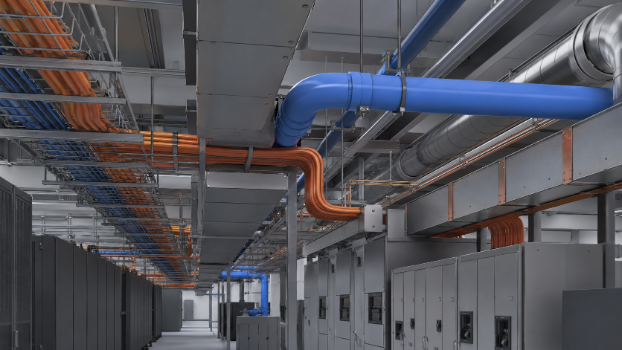
The Real Reason Coordination Issues Keep Reappearing
Coordination issues in data center projects rarely keep reappearing because one trade missed one clash. They return because the project team solves the visible conflict without validating the deeper system logic behind it. In a mission-critical facility, BIM coordination is not just about moving conduits around ductwork or clearing a cable tray from a pipe run. It is about protecting uptime, redundancy, service access, power distribution, cooling performance, constructability, and future operations inside one verified model. When coordination meetings produce decisions but the coordination model, field sequence, and responsibility structure do not fully reflect those decisions, the same problems resurface later as rework, downtime risk, delayed installation, or expensive redesign.
The Real Reason Coordination Issues Keep Reappearing in Data Center Projects
Recurring coordination issues usually come from a gap between discussion and verification. A clash may be marked “resolved,” but if the updated route is not checked against electrical clearances, A/B power paths, maintenance access, and construction sequencing, the issue has only changed shape.
In data center BIM coordination, every system carries operational weight. Electrical, mechanical, cooling, fire protection, low-voltage, and monitoring systems all compete for space, but they also depend on each other. A small routing change can affect load distribution, airflow management, backup capacity, or equipment replacement access.
Why Data Centers Are Less Forgiving Than Typical Buildings
A standard commercial building may tolerate some late adjustment in the field. A data center does not offer that flexibility. Power infrastructure, cooling systems, and redundancy architecture are tightly connected to uptime and reliability.
Switchgear rooms, UPS systems, generators, PDUs, RPPs, cable trays, conduits, bus duct, chilled water systems, CRAH units, and HVAC systems all need defined space, access, and routing. If one system shifts late, it can trigger rework across multiple trades.
The Difference Between Fixing a Clash and Solving a Coordination Problem
Clash detection identifies a physical conflict. It does not prove the solution is buildable, maintainable, or aligned with redundancy requirements.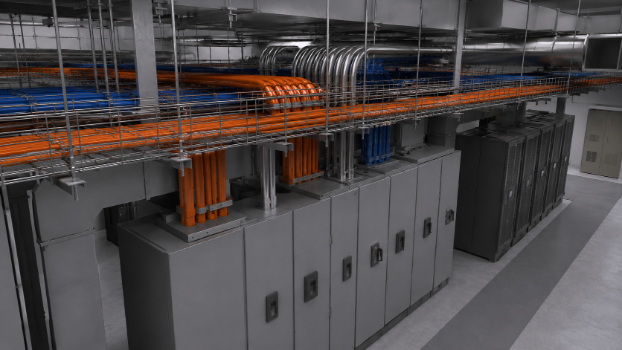
A conduit reroute may clear a duct but violate NEC clearance. A cable tray may avoid a pipe but block service access. A bus duct may fit geometrically but create future expansion issues. True BIM coordination requires verification, not just a clean clash report.
Why Coordination Issues Keep Coming Back
Coordination problems repeat when workflows are built around meetings instead of accountable model updates. The real failure is often not technical knowledge. It is weak responsibility management, poor version management, incomplete LOD control, and missing recheck steps.
Coordination Meetings Without Model-Based Confirmation
Coordination meetings are useful only when decisions become traceable model changes. Notes, screenshots, and verbal agreements are not enough in complex data center construction.
Each decision should identify the responsible trade, required model update, affected systems, and final verification step. Without that loop, unresolved BIM clashes quietly return in later model versions or during installation.
Weak Ownership of Clash Resolution
When no one owns the final fix, clashes drift. Electrical coordination may depend on mechanical rerouting. Cooling ducts may wait on structural confirmation. Low-voltage pathways may be pushed aside until space is gone.
A clash ownership matrix helps prevent this. It makes responsibility visible and forces decisions to move from “someone needs to adjust this” to “this trade owns this update by this model cycle.”
Poor Version Management Across Models
Many recurring coordination issues come from teams working from outdated files. The federated model may show one condition while shop drawings, fabrication models, or field crews follow another.
Version management must control the coordination model, fabrication-ready model, and as-built model. If updates are not synchronized, the project can appear coordinated digitally while the field installs from old information.
LOD Gaps and Incomplete Constructability Detail
Low-detail models create false confidence. A cable tray shown as a simple box may not reflect supports, bend radius, access, or real installation constraints.
Level of Detail and LOD control matter most around switchgear, UPS systems, bus duct routing, conduits, feeders, breakers, panels, and maintenance access zones. If the model lacks constructability detail, the field becomes the place where coordination actually happens.
The Electrical Coordination Problem Behind Many Data Center Delays
Electrical systems are often the hardest to recover once coordination slips. Power distribution is path-dependent, space-intensive, and tied directly to uptime. Moving electrical infrastructure late is rarely simple.
Power Distribution Systems Need More Than Space Reservation
Power distribution requires more than reserved rooms and rough pathways. Utility feeds, main switchgear, PDUs, RPPs, feeders, breakers, and breaker schedules must align with load balancing, load distribution, access, and backup strategy.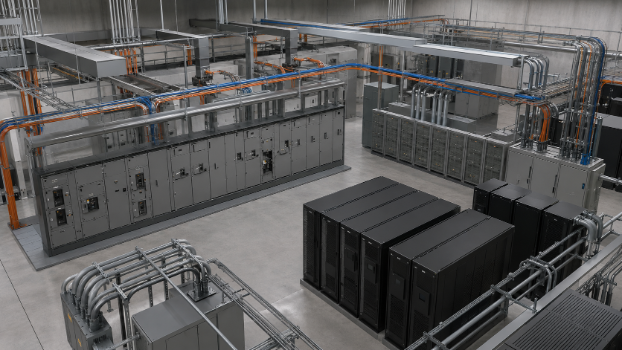
If electrical distribution systems are coordinated only by geometry, the model may miss operational logic. Feeder optimization, future capacity, and serviceability must be reviewed early.
Cable Tray, Conduit, and Bus Duct Routing
Cable trays, conduits, and bus duct often become recurring clash zones because they run through already congested overhead spaces. Their routes affect structural supports, cooling ducts, access zones, and installation sequence.
UPS routing and bus duct routing should be treated as electrical backbone coordination, not late trade cleanup. Once these routes are compromised, field changes become expensive.
UPS Systems and Backup Power Coordination
UPS systems, uninterruptible power supply equipment, backup generators, generator distribution, and redundant feeds are central to fault tolerance. Their coordination must protect backup capacity and maintenance access.
A UPS room that is physically coordinated but difficult to service is not truly coordinated. Mission-critical reliability depends on both equipment layout and long-term operational access.
Redundancy Models Must Be Coordinated as Separate Systems
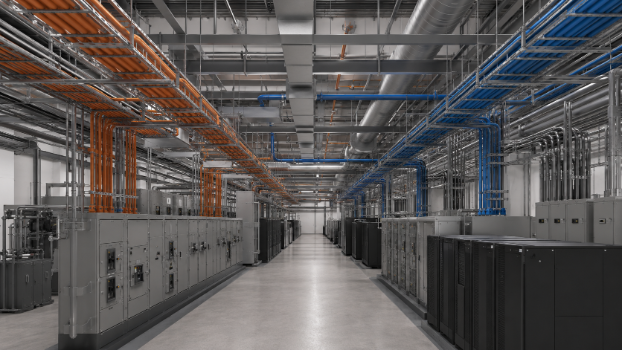
Redundancy is not just a design label. A/B power paths, dual power paths, and redundant power paths must be modeled, separated, and validated.
Understanding N, N+1, and 2N Coordination Requirements
An N configuration provides the required baseline capacity. N+1 adds backup capacity. 2N redundancy duplicates critical infrastructure. Each model changes space planning, routing, equipment count, and maintenance strategy.
Higher redundancy improves reliability, but it also increases coordination complexity.
Tier III, Tier IV, and Uptime Expectations
Tier III and Tier IV environments create stricter expectations around concurrent maintainability and fault tolerance. Uptime Institute standards and five nines availability are not achieved through equipment selection alone.
They depend on disciplined coordination of redundant electrical systems, cooling, access, and maintenance workflows.
Why Redundant Paths Still Fail in Coordination
Redundant paths fail when A-side and B-side systems share hidden vulnerabilities. They may cross in congested zones, depend on the same access route, or conflict with mechanical systems.
Model segmentation, access validation, and redundancy validation make these risks visible before construction.
Cooling Coordination Is Directly Connected to Power Reliability
Power and cooling cannot be coordinated separately. High-density racks, AI workloads, GPU workloads, and rising power density increase heat load and reduce tolerance for layout errors.
Chilled Water Systems, CRAH Units, and Cooling Plant Coordination
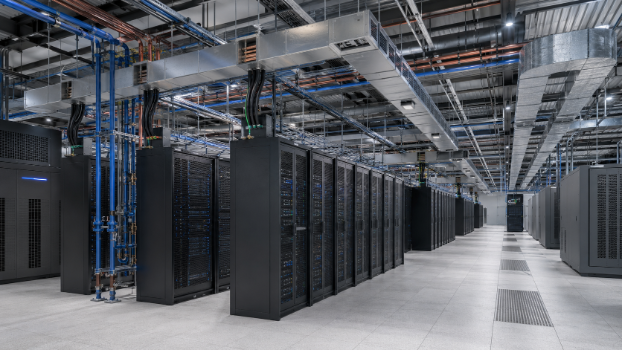
Chilled water systems, chilled water plants, chillers, cooling towers, pumps, CRAH units, and HVAC systems require space for routing, access, and replacement.
These systems often compete directly with electrical pathways, especially in dense infrastructure areas.
Airflow Management and Containment
Airflow management affects uptime and energy efficiency. Hot aisle, cold aisle, hot aisle containment, and cold aisle containment must align with rack layout and cooling delivery.
Blocked airflow or poorly coordinated cooling ducts can increase operating costs and reduce system reliability.
Liquid Cooling and High-Density AI Infrastructure
Liquid cooling and direct-to-chip cooling are becoming more important as AI workloads grow. These systems introduce new routing, maintenance, leak-risk, and access requirements.
Future-ready coordination must account for higher rack densities and future expansion zones.
Clearance, Access, and Code Requirements Are Often Underestimated
A model can be clash-free while still failing access requirements. Clearances must be validated as intentionally as physical collisions.
Electrical Room Clearances and NEC 110.26
NEC clearance and NEC 110.26 clearance are critical around switchgear, panels, breakers, UPS systems, and electrical rooms. Conduits, trays, and mechanical systems cannot invade working space.
Maintenance Access Is a Coordination Requirement, Not an Afterthought
Maintenance access zones, service access, and equipment access should be modeled early. Facility management depends on the ability to inspect, repair, and replace equipment without creating downtime.
Construction Sequencing and Phased Delivery Can Recreate Old Issues
Even a coordinated model can fail when sequencing is ignored. Phased deployment, white space buildout, underfloor coordination, raised floor coordination, and future expansion must match the construction plan.
Prefabrication Requires Fabrication-Ready Coordination
Prefabrication and modular infrastructure reduce field labor, but they demand earlier accuracy. A fabrication-ready model must be verified before racks, skids, bus duct, or cable tray assemblies are produced.
Future Expansion Zones Must Be Protected
Future expansion zones are often lost when current routing pressures increase. Protecting them preserves scalability for future power, cooling, and IT load growth.
Monitoring, Digital QA, and As-Built Data Help Stop the Repeat Cycle
Digital QA turns coordination from a meeting process into a verification process. It connects decisions, updates, field feedback, and final conditions.

From Coordination Model to As-Built Model
The as-built model should reflect installed infrastructure, not design intent. Accurate BIM data supports maintenance, troubleshooting, and future expansion.
Real-Time Monitoring and Power Monitoring
Real-time monitoring, monitoring dashboards, power monitoring, and load balance data help teams understand how systems perform after turnover.
Digital Twins and Predictive Maintenance
A digital twin connects BIM, operations, predictive maintenance, and facility management. This creates a feedback loop that reduces future coordination blind spots.
Efficiency, Energy Use, and Sustainability Are Now Part of Coordination
Coordination affects energy consumption, operating costs, and sustainability. Poor routing, blocked airflow, and inefficient cooling can increase PUE and reduce performance.
Coordination’s Impact on Energy Efficiency
Better airflow management, load distribution, and cooling coordination can support energy optimization and reduced compressor load.
Sustainability Metrics and Long-Term Data Center Performance
Power Usage Effectiveness, greenhouse gases, water usage, and energy efficiency are now tied to infrastructure decisions. Sustainability starts with coordinated systems.
How to Prevent Coordination Issues from Reappearing
The solution is not more meetings. It is stronger model-based verification.
Build a Strong BIM Execution Plan
A BIM execution plan should define LOD control, model standards, responsibilities, update cadence, clash rules, and sign-off requirements.
Use Model Segmentation for Complex Systems
Model segmentation by phase, trade, area, or redundancy path improves visibility and accountability.
Add a Mandatory Recheck Step After Every Coordination Decision
Every coordination decision needs a recheck step in the updated model. This is where recurring issues are actually stopped.
Validate Redundancy, Access, and Installation Sequence Together
Redundancy validation, access validation, NEC clearance, and construction sequencing must be reviewed together, not separately.
Future Trends in Data Center Coordination
The next generation of data centers will be denser, faster, and less forgiving.
AI Workloads Will Increase Power and Cooling Density
AI workloads and GPU workloads will increase power density, cooling demand, and routing complexity.
Modular and Prefabricated Systems Will Demand Earlier Coordination
Modular infrastructure and prefabrication will reward teams that coordinate accurately before fabrication starts.
Digital Twins Will Connect Construction and Operations
Digital twins, monitoring dashboards, and predictive maintenance will bring construction data into daily operations.
Conclusion: Coordination Must Be Verified, Not Just Discussed
Coordination issues keep reappearing when teams treat clash detection as the finish line. In data centers, real coordination means verifying electrical distribution, redundancy, cooling, access, sequencing, monitoring, and sustainability together. The projects that perform best do not just discuss coordination. They prove it in the model, validate it in the field, and carry it into operations.