
The BIM Coordination Bottleneck in Data Center Projects
Data center construction pushes BIM coordination to its limits. Unlike conventional projects, these facilities demand absolute precision across power, cooling, and network infrastructure, all operating simultaneously within tight spatial constraints. The result is a coordination environment where even minor misalignments can cascade into rework, delays, or risks to uptime. What often appears as a coordination issue on paper is, in reality, a systemic bottleneck driven by density, redundancy requirements, and the need for flawless execution in mission-critical environments.
BIM Coordination in Data Centers: Why It Becomes a Bottleneck
The role of BIM coordination in mission-critical projects
BIM coordination in data centers goes far beyond aligning models. It acts as the control layer that ensures electrical infrastructure, cooling, and network systems function without interruption. In mission-critical environments, coordination directly impacts uptime and latency. A poorly coordinated conduit run or misaligned bus duct is not just a design flaw, it is a potential failure point in a facility designed for continuous operation.
Where coordination fails in complex environments
The bottleneck typically emerges at the intersection of multiple systems. MEPFP coordination becomes strained as cable trays, HVAC ducts, and conduits compete for limited space. Without robust issue tracking and a shared common data environment, teams work on fragmented assumptions. Model validation often lags behind design updates, leading to unresolved clashes and inaccurate clearances that only surface during construction.
The cost of poor coordination
When coordination breaks down, rework becomes inevitable. Field teams are forced to reroute conduits, adjust cable trays, or modify hanger placements. These changes disrupt schedules and compromise constructability. In fast-track data center builds, even small coordination errors can delay commissioning and affect the overall delivery timeline.
Core BIM Coordination Workflows and Processes
Clash detection and model validation
Clash detection remains the first line of defense, but its effectiveness depends on disciplined model validation. In high-density environments, soft clashes such as insufficient clearance or maintenance access often matter more than hard collisions. Rule-based checks must verify spacing around switchgear, UPS systems, and cooling equipment to ensure operational viability, not just geometric alignment.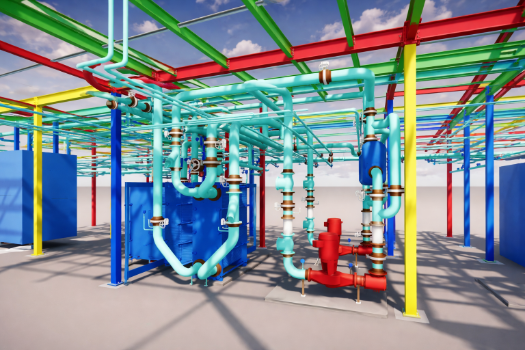
Issue tracking and collaboration systems
Effective coordination depends on structured issue tracking. Each clash or coordination gap must be assigned, tracked, and resolved within defined timelines. Without this discipline, coordination meetings become repetitive cycles rather than decision-making platforms. Clear ownership and accountability are critical to maintaining momentum.
Common data environment and coordination platforms
A well-managed common data environment eliminates version conflicts and ensures all stakeholders operate on the latest model. It provides a single source of truth for coordination decisions, reducing miscommunication between electrical, mechanical, and construction teams.
4D BIM and coordination sequencing
4D BIM introduces a temporal dimension, aligning coordination with construction sequencing. This is particularly important in data centers where installation order affects accessibility. For example, installing busways before HVAC systems can simplify routing and reduce clashes, but only if sequencing is properly coordinated in the model.
Electrical Infrastructure: The Core of Coordination Complexity
Power distribution systems in data centers
Power distribution is the backbone of any data center. Coordinating transformers, switchgear, and circuits within confined spaces requires precise modeling. Electrical distribution paths must be optimized not only for efficiency but also for maintainability and redundancy.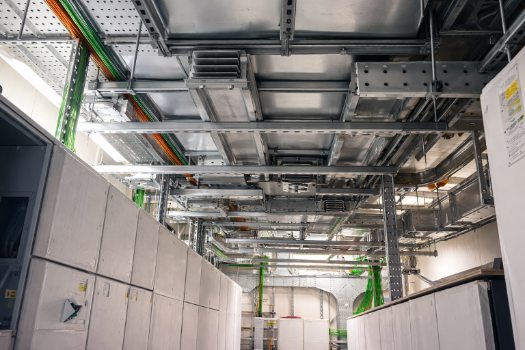
Redundancy models and system reliability
Redundancy drives complexity. Configurations such as N+1 or 2N require parallel routing of power systems, including UPS and backup generators. These redundant systems must remain physically separated to avoid single points of failure, creating additional coordination challenges in already dense environments.
Cable management and routing challenges
Cable trays, busways, and conduits compete for space alongside cooling infrastructure. Maintaining proper clearances while ensuring efficient routing is a constant balancing act. Misaligned cable tray systems can lead to congestion, complicating both installation and future maintenance.
Electrical analysis within BIM
Advanced coordination integrates engineering analysis. Load flow analysis ensures balanced distribution, while voltage drop calculations validate performance across long runs. Protective device coordination further ensures that faults are isolated without impacting the entire system.
MEP Systems and Cooling Coordination
MEPFP system integration in BIM
MEP coordination is where most bottlenecks manifest. Electrical, mechanical, and fire protection systems must coexist without interference. Each system has its own spatial and operational requirements, making integration a complex task.
Cooling systems and airflow management
Cooling is tightly coupled with power density. HVAC systems and airflow strategies must be coordinated with cable trays and electrical equipment to avoid thermal inefficiencies. Poor coordination can disrupt airflow patterns, leading to hotspots and reduced system performance.
Mission-critical performance considerations
Coordination decisions directly influence mission-critical performance. Latency, uptime, and reliability depend on the seamless integration of power and cooling systems. Even minor misalignments can affect system efficiency and long-term operability.
From Coordination to Constructability and Prefabrication
Fabrication-driven BIM workflows
Fabrication-driven BIM shifts the focus from design intent to buildability. Models are developed with sufficient detail to support fabrication, reducing ambiguity during construction.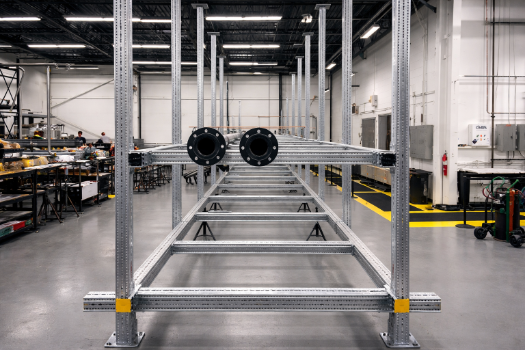
Prefabrication and modular construction
Prefabrication and modular construction are increasingly used to accelerate delivery. Accurate coordination enables components to be manufactured off-site and installed with minimal adjustments.
Spooling and shop production
Spooling of conduits and cable trays relies on precise coordination. Shop production benefits from consistent, clash-free models, improving efficiency and quality.
Hanger placement and installation readiness
Hanger placement is often overlooked but critical. Proper coordination ensures that supports are correctly positioned, reducing field modifications and improving installation speed.
Improving constructability and reducing rework
Ultimately, the goal is to enhance constructability. By resolving clashes and optimizing routing in the model, teams can minimize rework and streamline execution.
Commissioning, Monitoring, and Digital Continuity
Commissioning in coordinated environments
Commissioning validates that all systems operate as intended. BIM coordination supports this process by providing accurate system layouts and documentation.
Digital twins and lifecycle management
Digital twins extend BIM into operations. They provide a dynamic representation of the facility, enabling ongoing optimization and maintenance planning.
Monitoring systems and performance tracking
Integrated monitoring systems allow real-time tracking of performance. Linking these systems with BIM data enhances visibility and supports proactive management.
Efficiency, Sustainability, and Future Trends
Energy efficiency and performance optimization
Energy efficiency is a key driver in data center design. Coordinated power and cooling systems reduce waste and improve overall performance.
Renewable energy and energy storage integration
The integration of renewable energy and battery energy storage systems introduces new coordination challenges. These systems must align with existing electrical infrastructure without compromising reliability.
Advanced cooling technologies
Liquid cooling is gaining traction as power densities increase. Coordinating these systems with traditional HVAC infrastructure requires careful planning.
Sustainability and carbon reduction
Sustainability efforts focus on reducing embodied carbon and achieving net zero emissions. BIM coordination plays a role in optimizing material use and system efficiency.
Conclusion: Eliminating the BIM Coordination Bottleneck
Key takeaways for improving coordination
Effective BIM coordination requires more than tools. It demands disciplined workflows, accurate models, and strong collaboration across teams.
Future-ready coordination strategies
Emerging technologies such as digital twins and advanced analytics will further enhance coordination capabilities, enabling more resilient and efficient data centers.
Final perspective
The BIM coordination bottleneck is not just a technical challenge, it is an opportunity. When addressed correctly, it becomes a competitive advantage, enabling faster delivery, reduced risk, and higher-performing facilities.