
The Accountability Problem in Multi-Trade BIM Projects
In complex data center and mission-critical projects, BIM coordination is often treated as a visibility problem: if every trade can see the model, the project should be safer, cleaner, and easier to control. But visibility alone does not create accountability. In multi-trade BIM environments, the real issue is not only whether clashes are detected or models are updated. The deeper problem is knowing who owns each decision, who validates the impact, and who is responsible when a small unresolved change moves from the model into the field. When that accountability structure is weak, even a highly detailed BIM process can still produce rework, schedule pressure, and costly disputes.
The Hidden Gap Between Coordination and Accountability
BIM coordination meetings often create the impression that responsibility has been shared equally across the project team. Mechanical, electrical, plumbing, fire protection, structural, and architectural teams all review the same federated model, walk through the same clash reports, and agree on the same action items. On paper, this looks organized.
In practice, shared visibility can easily become shared ambiguity. A cable tray route may be visible to everyone, but that does not mean the electrical contractor owns every spatial conflict around it. A duct relocation may be proposed by the mechanical team, but it may impact electrical clearances, fire alarm pathways, access panels, structural embeds, and maintenance zones. The question is not simply who moved the object. The real question is who verified the downstream effect.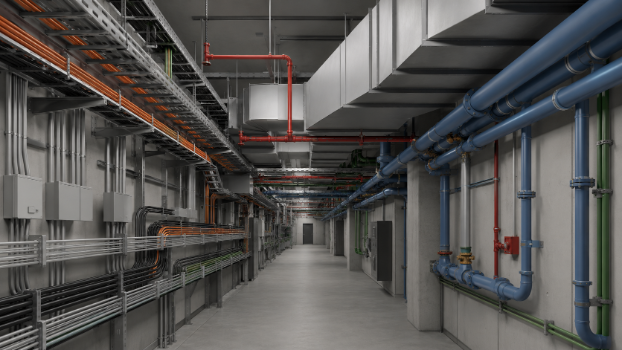
This is where many BIM workflows break down. Coordination identifies issues, but accountability determines whether those issues are fully resolved.
Why Multi-Trade BIM Projects Lose Ownership
Model Ownership Is Often Too Narrow
Most trades naturally focus on their own scope. Electrical teams protect switchgear rooms, busway alignment, feeder routes, cable tray capacity, conduit banks, grounding, lighting, and low-voltage pathways. Mechanical teams protect airflow, equipment access, duct sizes, hydronic piping, and clearance zones. Plumbing and fire protection teams do the same within their systems.
The problem is that data center infrastructure does not behave in isolated trade packages. A UPS room, generator yard, electrical corridor, or overhead utility rack is a shared technical environment. One system’s adjustment can quietly reduce another system’s maintainability, installation sequence, code clearance, or future expansion path.
When model ownership is defined only by trade boundaries, no one fully owns the interfaces. And in mission-critical facilities, the interfaces are often where the most expensive failures happen.
Clash Resolution Can Become a Checkbox
A clash report can show that an issue is “closed,” but that status does not always mean the design is buildable. It may simply mean two modeled objects no longer collide. That is a very low bar for coordination quality.
For example, moving a cable tray six inches to avoid a duct may clear the clash in Navisworks, but it could create a tighter bend radius, reduce working clearance, interfere with trapeze supports, or shift the route into a congested prefabrication zone. The software may show the conflict as solved, while the field team inherits a new problem.
This is why accountability has to go beyond clash count reduction. A mature BIM process asks whether the solution preserves installability, access, sequencing, safety, commissioning requirements, and long-term operations.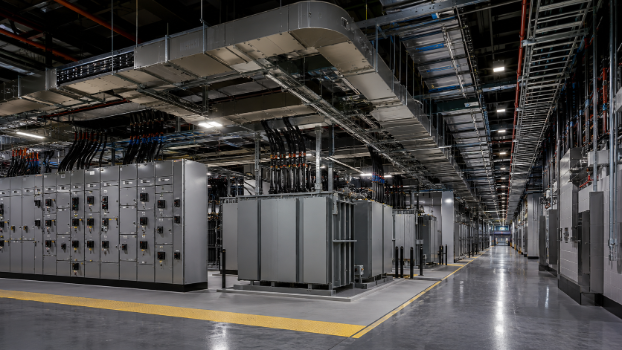
The Data Center Factor: Why Accountability Matters More Here
Data centers increase the cost of weak accountability because their infrastructure is dense, repetitive, and schedule-sensitive. Electrical architecture is especially unforgiving. Medium-voltage pathways, switchgear lineups, transformers, UPS systems, bus ducts, cable trays, conduits, generators, and grounding systems all require disciplined spatial control.
A minor shift in one area can multiply across the project. If a feeder pathway changes in a typical commercial building, the impact may be limited. In a data center, the same routing change may repeat across multiple electrical rooms, equipment galleries, white space zones, or phased capacity blocks. One unresolved coordination assumption can become a repeated construction defect.
The pressure is also different. Data center projects often move fast because owners are trying to bring capacity online quickly. Teams are coordinating while design is still evolving, procurement is active, prefabrication is underway, and field installation is already starting. In that environment, unclear accountability does not wait politely for the next meeting. It turns into RFIs, field workarounds, late redesign, material waste, and schedule compression.
Where Accountability Breaks Down in the BIM Workflow
During Trade Model Updates
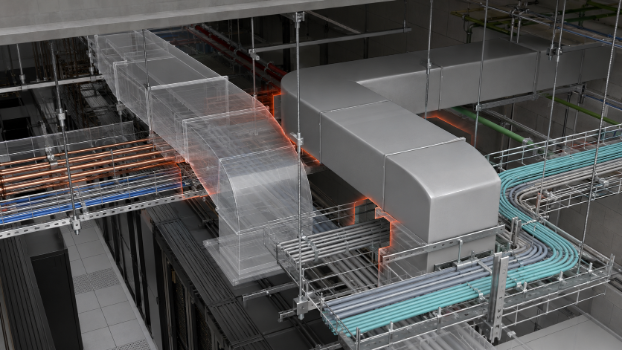
Many accountability issues begin when a trade updates its model without a clear impact review. The update may be technically correct within that trade’s scope, but it can disrupt the coordinated environment. A resized duct, rerouted pipe, revised tray elevation, or shifted support frame can invalidate previous coordination decisions.
The issue is not that changes happen. Changes are inevitable. The issue is whether each change is traceable, reviewed, and communicated with enough context for affected trades to respond before the field is exposed.
 During Issue Assignment
Issue assignment can also be misleading. A coordination platform may assign an issue to one company, but the solution may require three or four trades to participate. If the assigned party closes the issue without joint validation, the project may gain administrative progress without technical resolution.
This is especially common with ceiling congestion, corridor routing, electrical room access, and shared support systems. The responsible party may fix the immediate object conflict, while the broader constructability risk remains.
During Field Translation
The model is not the end product. The installed facility is. Accountability fails when coordinated model decisions are not clearly translated into field layout, prefabrication drawings, spool drawings, installation sequencing, and QA checks.
A model may show the correct elevation, but the field crew may receive drawings that lag behind the latest coordination decision. A prefabricated rack may be built from an earlier model export. A subcontractor may install based on a partial area release while another trade is still revising nearby systems. These are not software problems. They are control problems.
What Strong BIM Accountability Actually Looks Like
Strong accountability starts with clear ownership of both scope and interfaces. Each trade should own its systems, but the project also needs defined responsibility for cross-trade zones, high-risk corridors, electrical rooms, equipment pads, access paths, and prefabricated assemblies.
It also requires disciplined change control. Every meaningful model change should answer three questions: what changed, why it changed, and who is affected. Without that structure, teams waste time rediscovering impacts that should have been visible from the start.
A strong process also separates clash clearance from coordination approval. A clash may be cleared by a modeler, but a coordination decision should be validated by people who understand installation, sequencing, code compliance, access, and commissioning. This distinction is critical in data center work, where the cost of a poor routing decision can be much larger than the clash itself.
Finally, accountability requires version clarity. Teams need to know which model is current, what changed between versions, which issues were closed, which issues were deferred, and which areas are released for fabrication or installation. Without version discipline, even good coordination decisions can be lost.
The Role of Leadership in Fixing the Problem
Accountability cannot be delegated entirely to BIM coordinators. BIM teams can detect, document, and organize issues, but project leadership must define decision rights and enforce follow-through. General contractors, construction managers, design leads, and trade leads all need a shared understanding of what “resolved” actually means.
On high-performing projects, coordination meetings are not just model reviews. They are decision forums. The team does not only ask, “Is the clash gone?” They ask, “Is this solution buildable, approved, sequenced, and communicated to the field?”
That shift changes the value of BIM. It moves the process from digital problem spotting to project control.
From Shared Models to Shared Responsibility
The accountability problem in multi-trade BIM projects is not caused by a lack of technology. Most teams already have enough tools to find clashes, assign issues, compare models, and document changes. The real challenge is operational discipline.
A federated model can show where systems intersect, but it cannot automatically decide who owns the consequence of every change. That responsibility has to be designed into the workflow.
For data center projects, this is not a small improvement. It is a core requirement for controlling cost, schedule, quality, and risk. The teams that succeed are not the ones with the most detailed models alone. They are the ones that connect model detail to clear ownership, fast decision-making, and disciplined field execution.